
Sold Archive
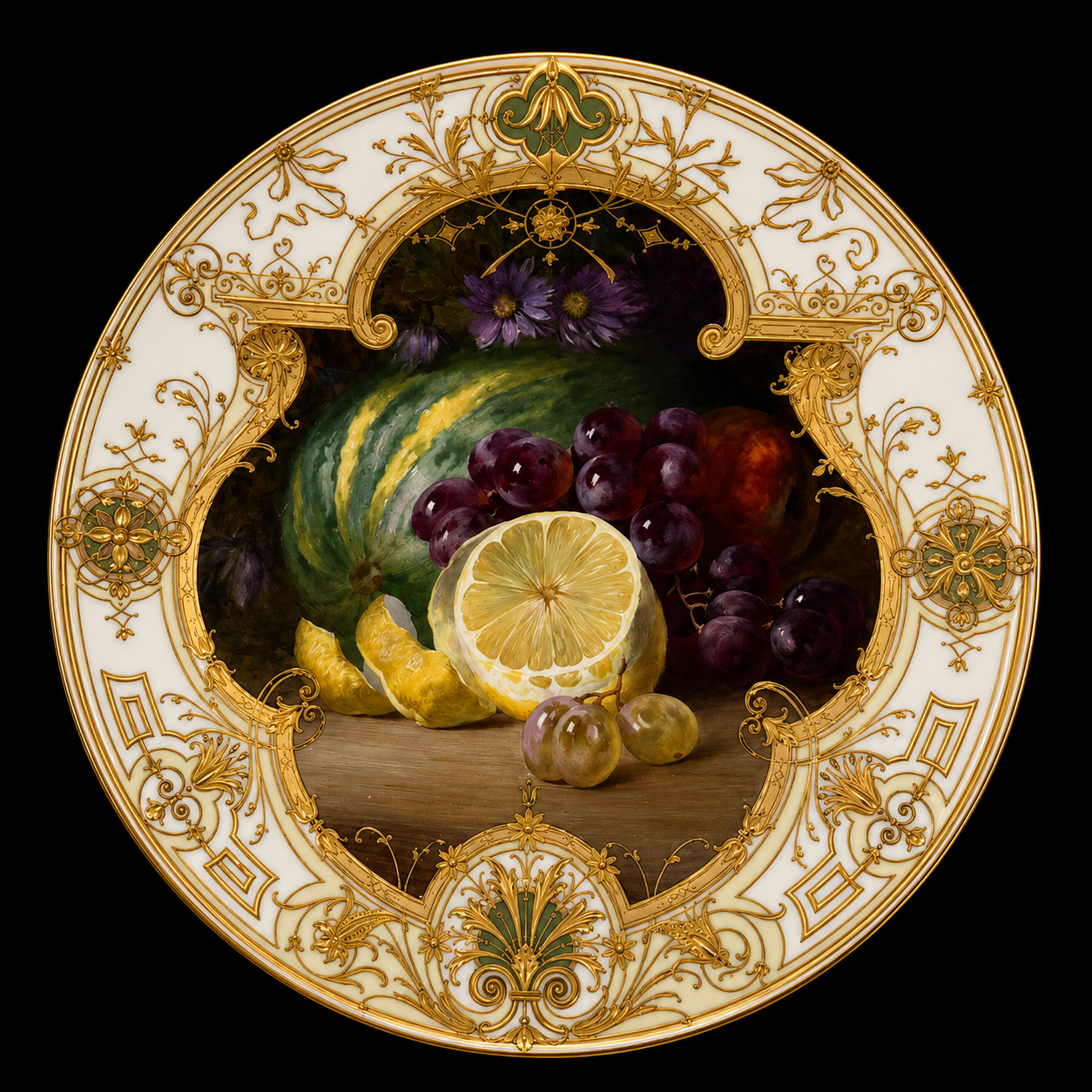
Description BERLIN (KPM) PORCELAIN IVORY-GROUND WEICHMALEREI CHARGER circa 1900, blue sceptre and iron-red orb marks, impressed U and cypher, painted script er., in the Neo-Rococo Jugendstil taste, finely painted in a soft palette with still lifes of fruit and flowers, including grapes, watermelon and lemon, D: 14 in.
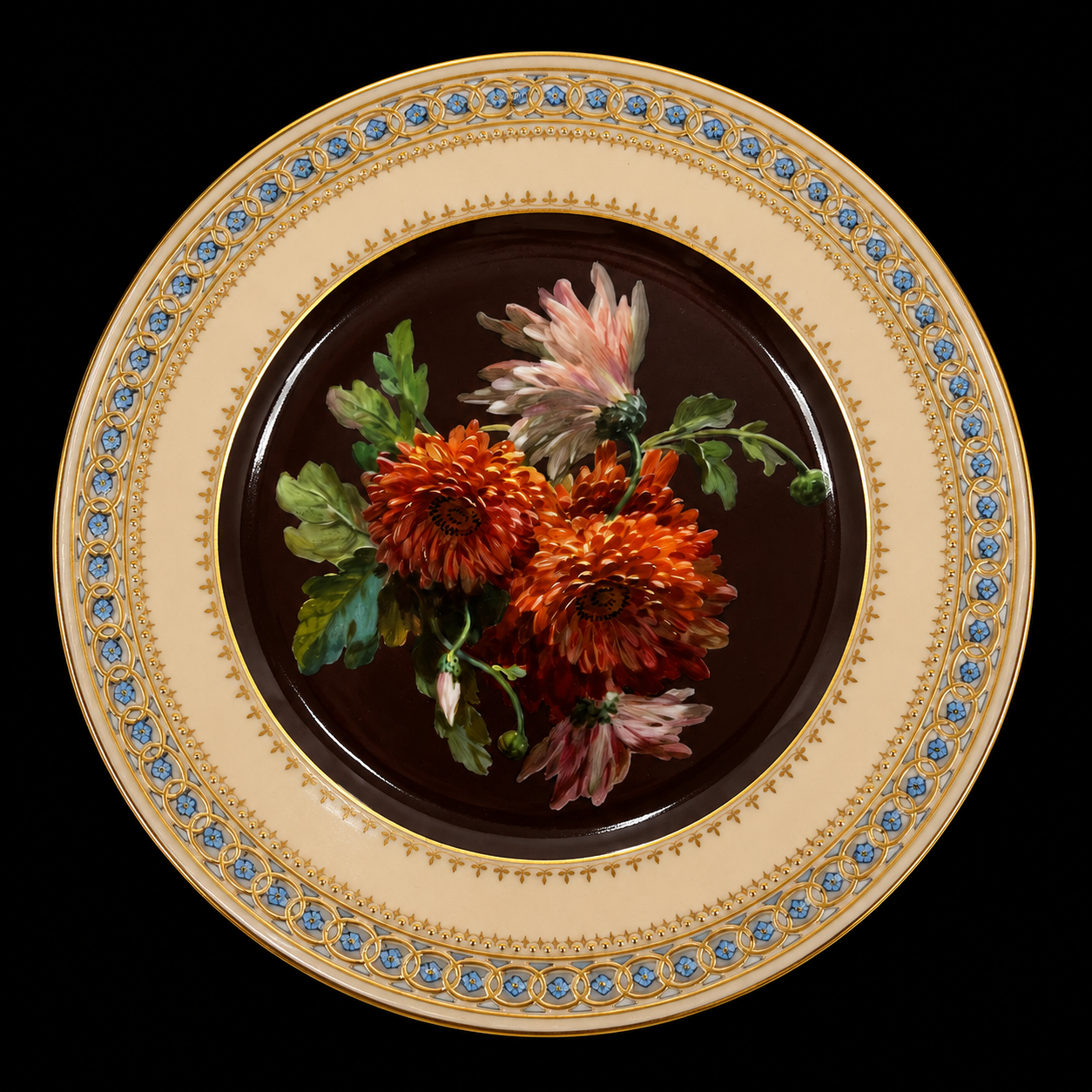
A fine Meissen cabinet plate with a reticulated border, 19th century, This is an amazing plate made by Meissen in the 19th century. It is a plate decorated by Professor Julius Eduard Braunsdorf who worked at Meissen from 1858 until 1906 and is famous for painting the most beautiful and realistic looking flowers. Prof. Braunsdorf studied at the Art Academie in Dresden before coming to Meissen and is amoung the most important floral painters ever. This plate is a perfect example of his work and these types of plates are very very rare and hard to find, with gilt enrichments, blue underglaze crossed swords mark underside, diameter 22.5 cm
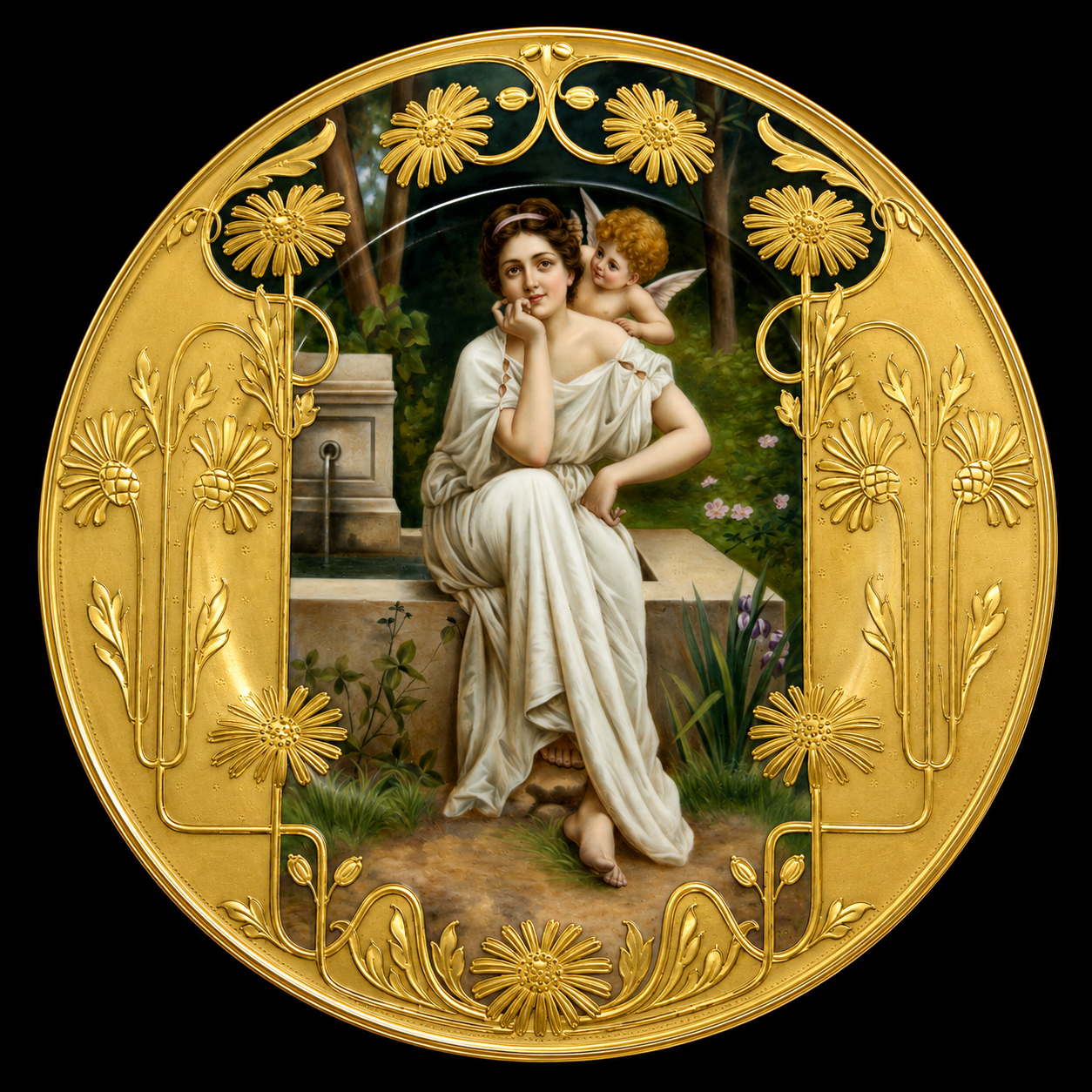
ANTIQUE ROYAL VIENNA HAND PAINTED PLATE Late 19TH CENTURY, UNDERGLAZE BLUE BEEHIVE MARK, Titled "Waldesflustern",Skillfully Hand Painted portrait, within raised gilded border Signed Wagner Diameter: 9 3/4" diameter Condition Report: Excellent
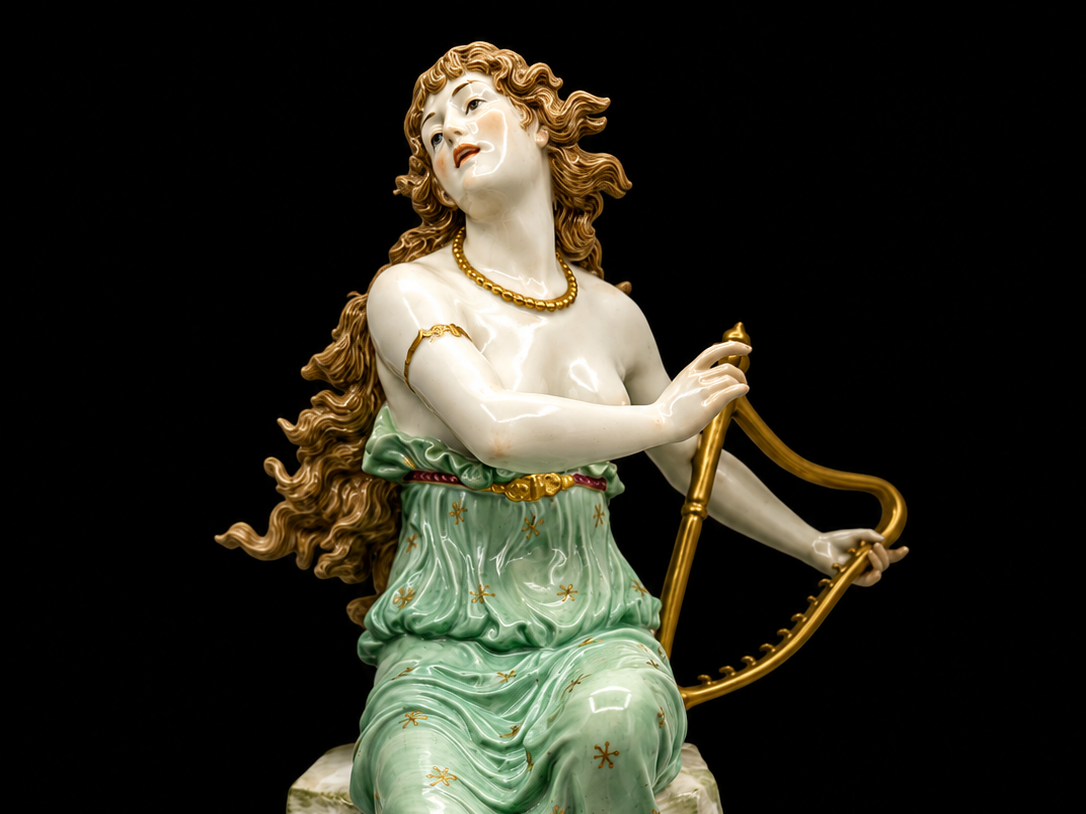
Meissen figure LoreleyLATE 19TH CENTURY, BLUE CROSSED SWORDS MARK, INCISED MODEL NO. O153, Modelled with Loreley sitting on a rock with a harp (34 cm.) high
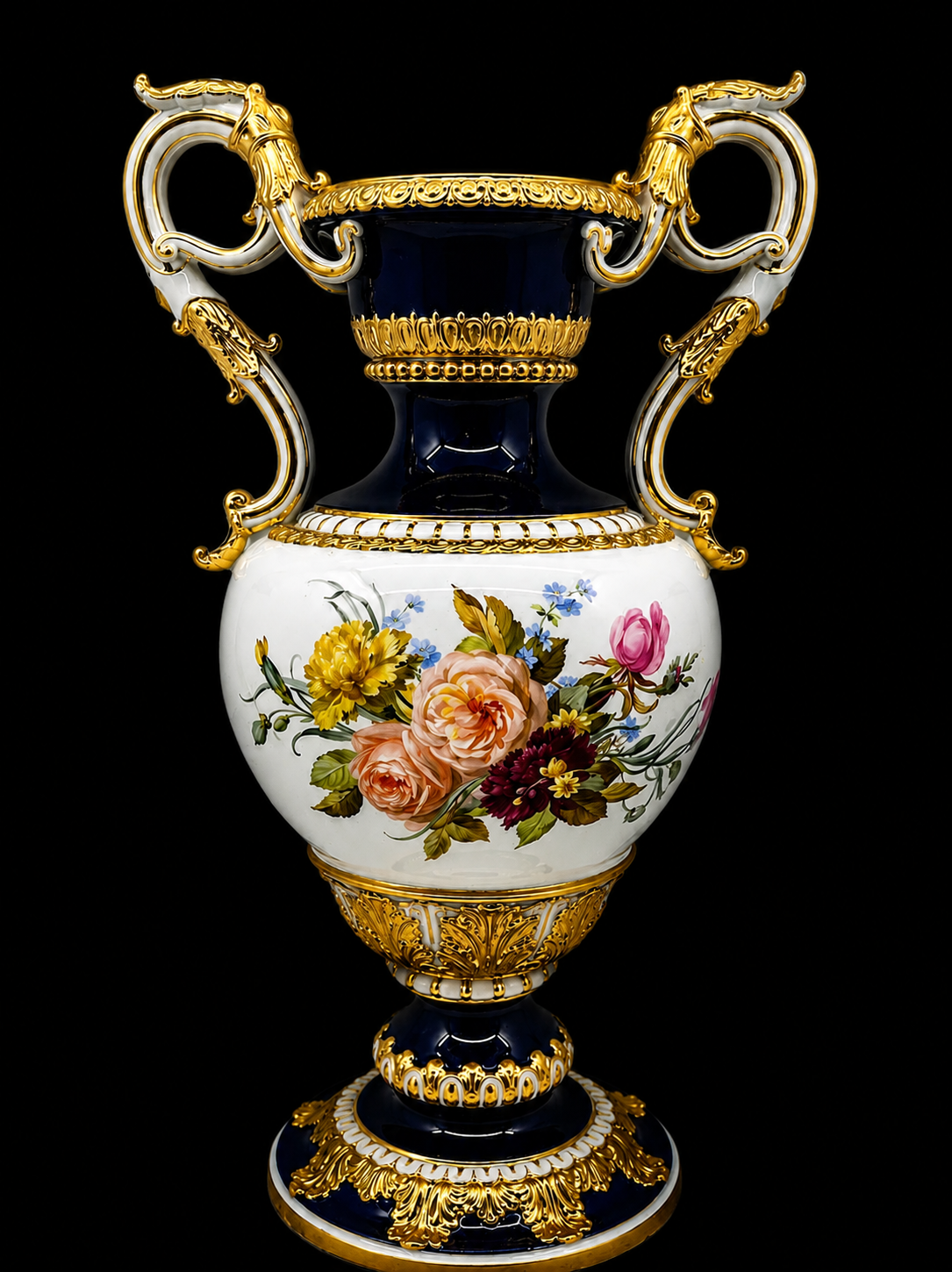
The Meissen vase Circa 1890 is painted with large flowers and roses to both sides, base and lower part of vase with leaves in relief, highlighted in gild, scroll handles and cobalt.Meissen blue cross sword and impressed numbers, Meissen circa 1890.DimensionsHeight approx. 23.5 in (60cm)
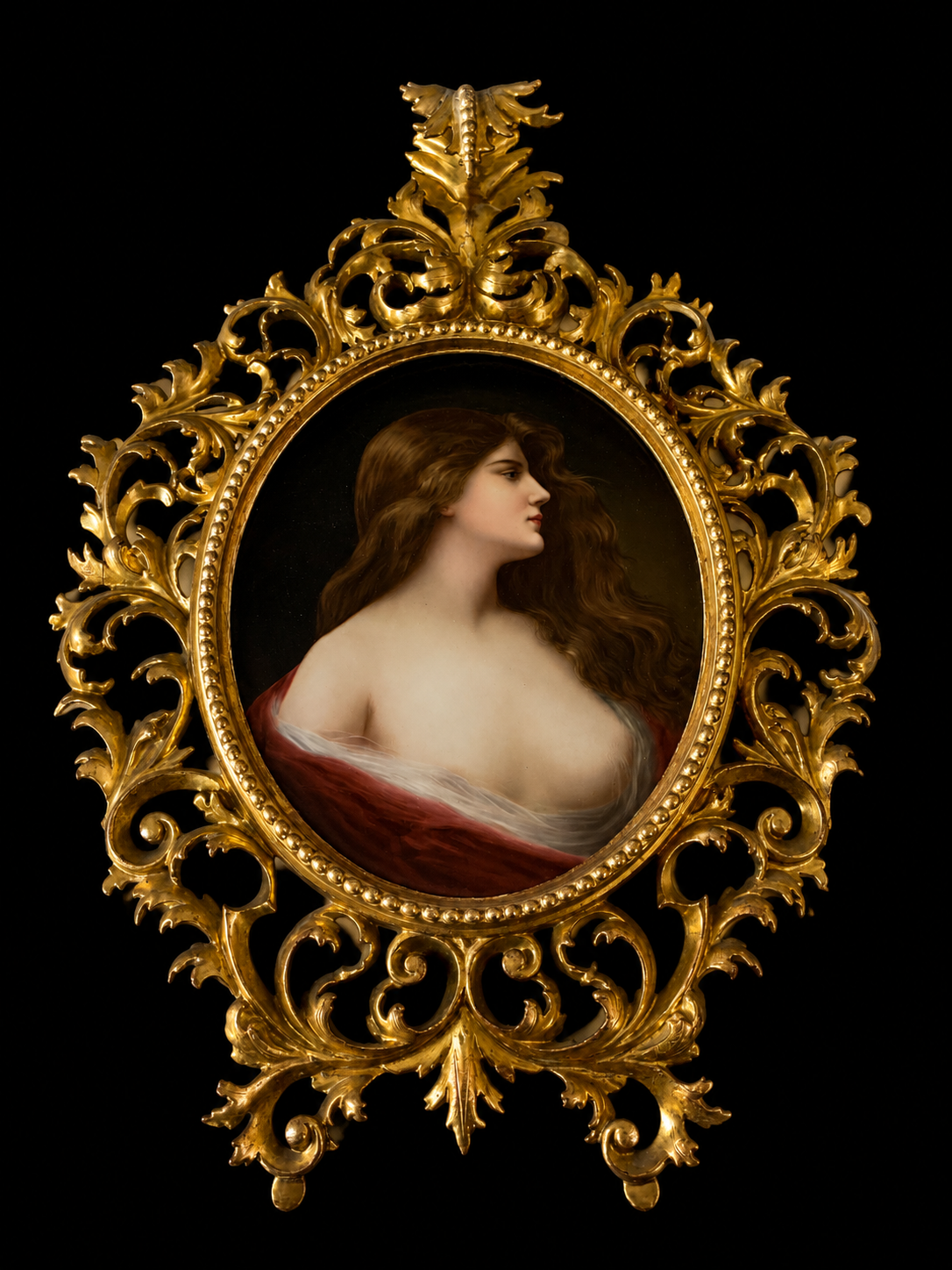
Framed oval KPM porcelain plaque, 'EPANOUISSEMENT' signed Wagner, late 19th century, impressed monogram and sceptre, various impressed cyphers, stamped ''Germany'' verso, with incised KPM mark, titled in ink on the reverse''Erbluht'' after Asti, approx. 13''h x 10.75''w, in later Italian hand carved and water gilt frame, approx. 20''h.
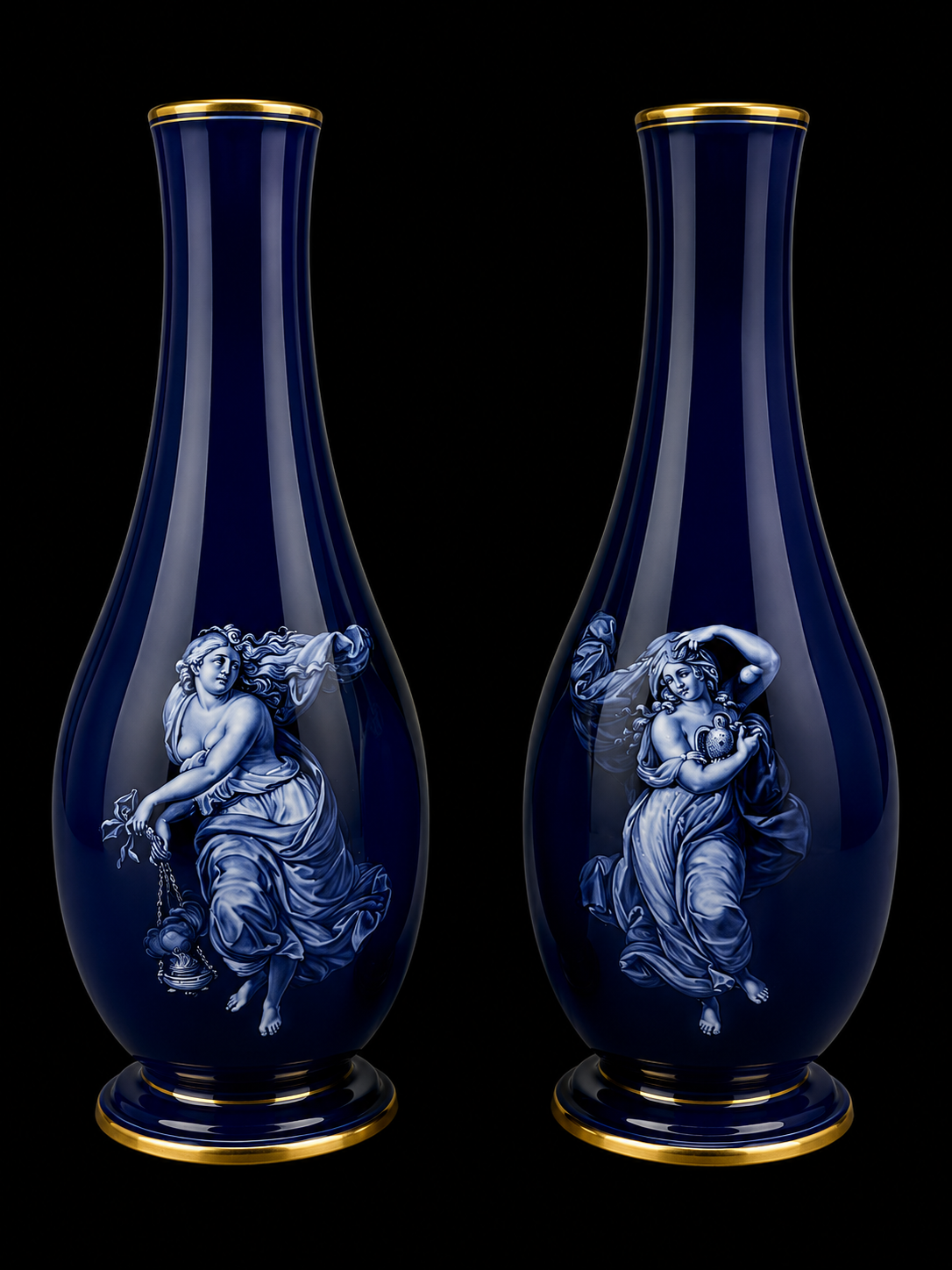
MEISSEN 'LIMOGES ENAMEL' PAIR OF VASES late 19th/early 20th Century, both with underglaze blue crossed swords mark, in the manner of E. A. Leuteritz, the vase with incised number, having a cobalt blue ground, the vase decorated with mythological scenes on each side, h: 7.5 in.
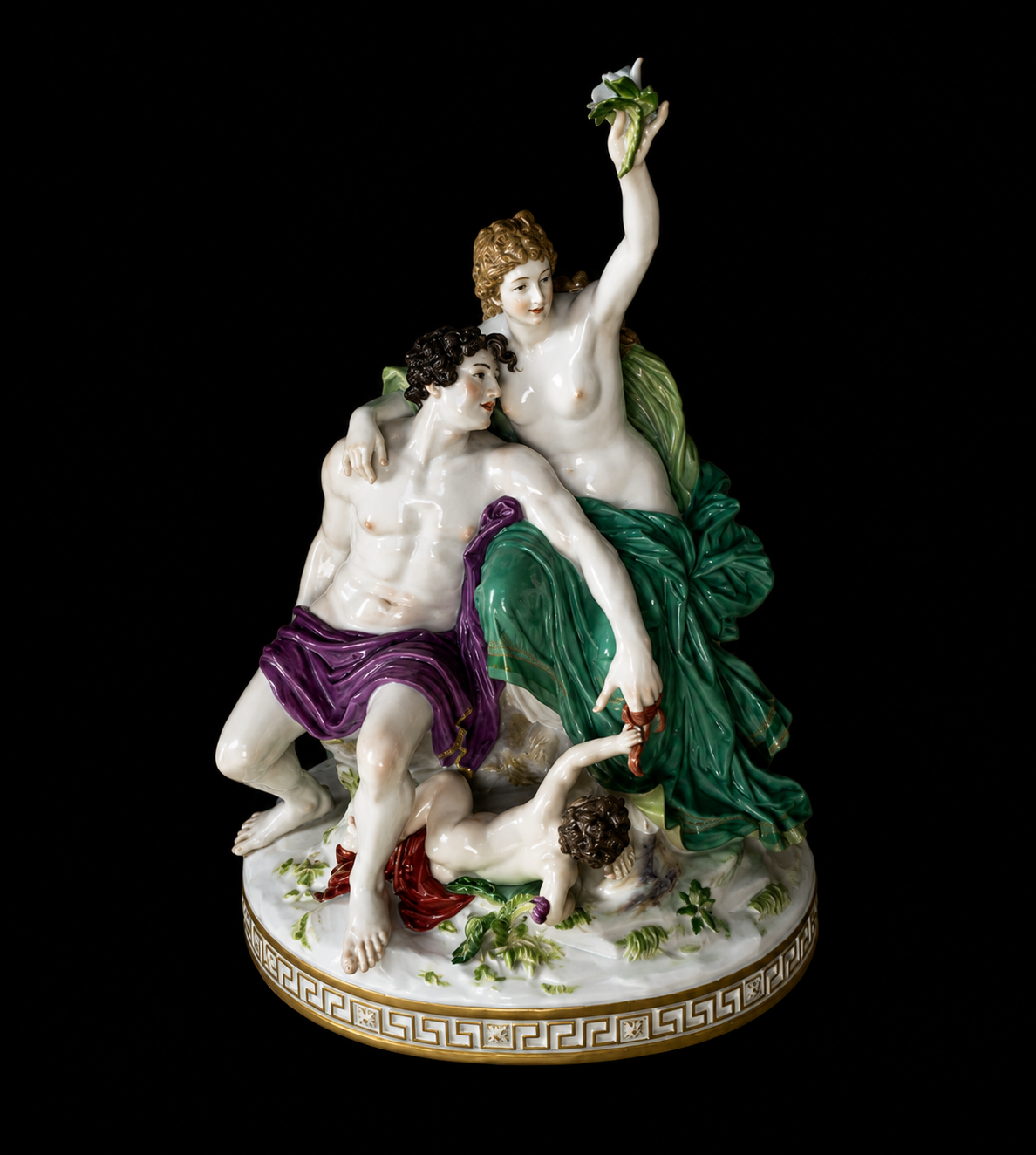
Allegory of Victory about to crown an athlete , attended by a putto.
Model Number: O 179
Height: 17″
Modeled c.1890 by Emmerich Andresen
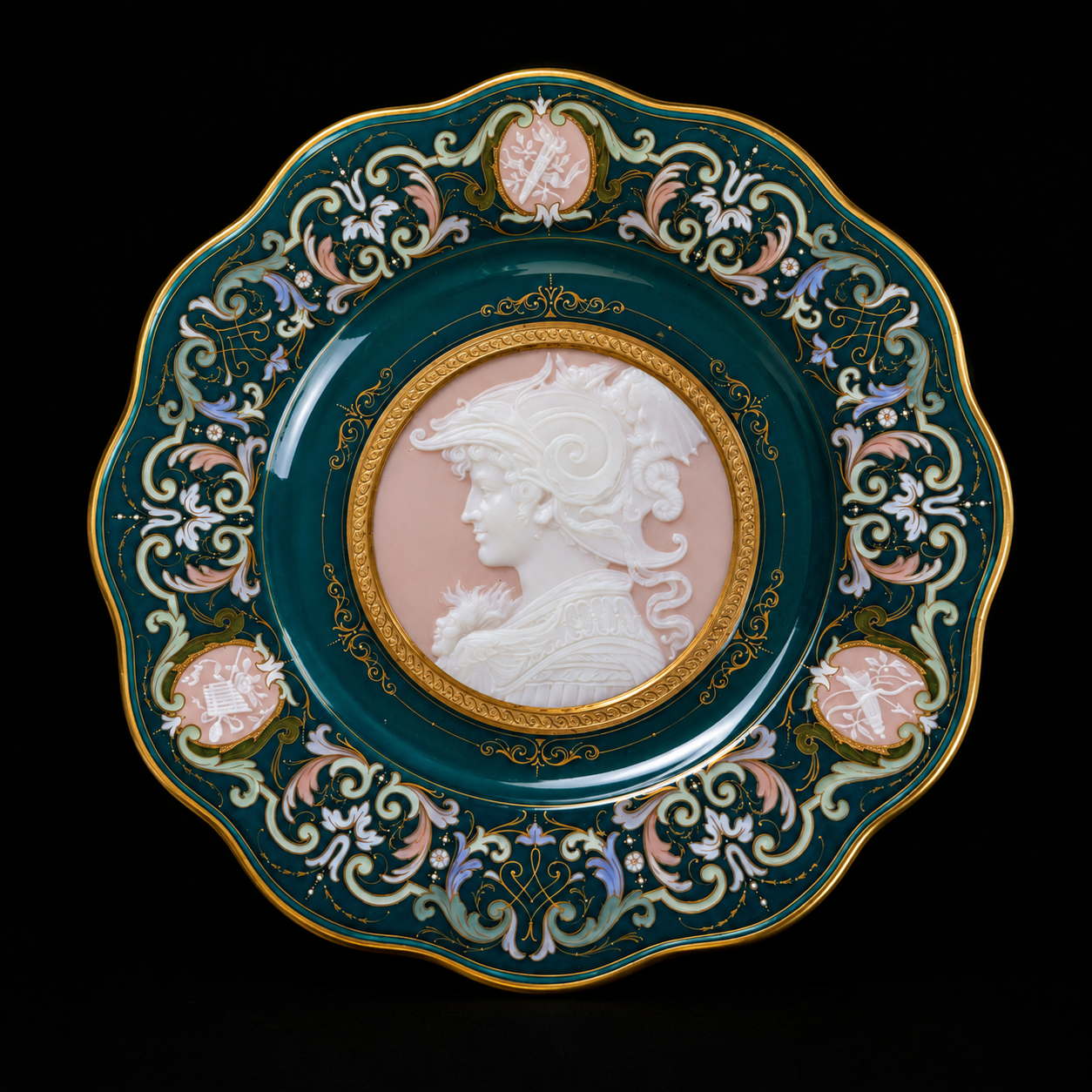
Profile of a mythological woman on pink ground in center encircled by scrolling foliate decoration on teal blue ground, with gilt details and scalloped edge, late 19th c.; Underglaze blue double sword mark; 9 5/8" dia.
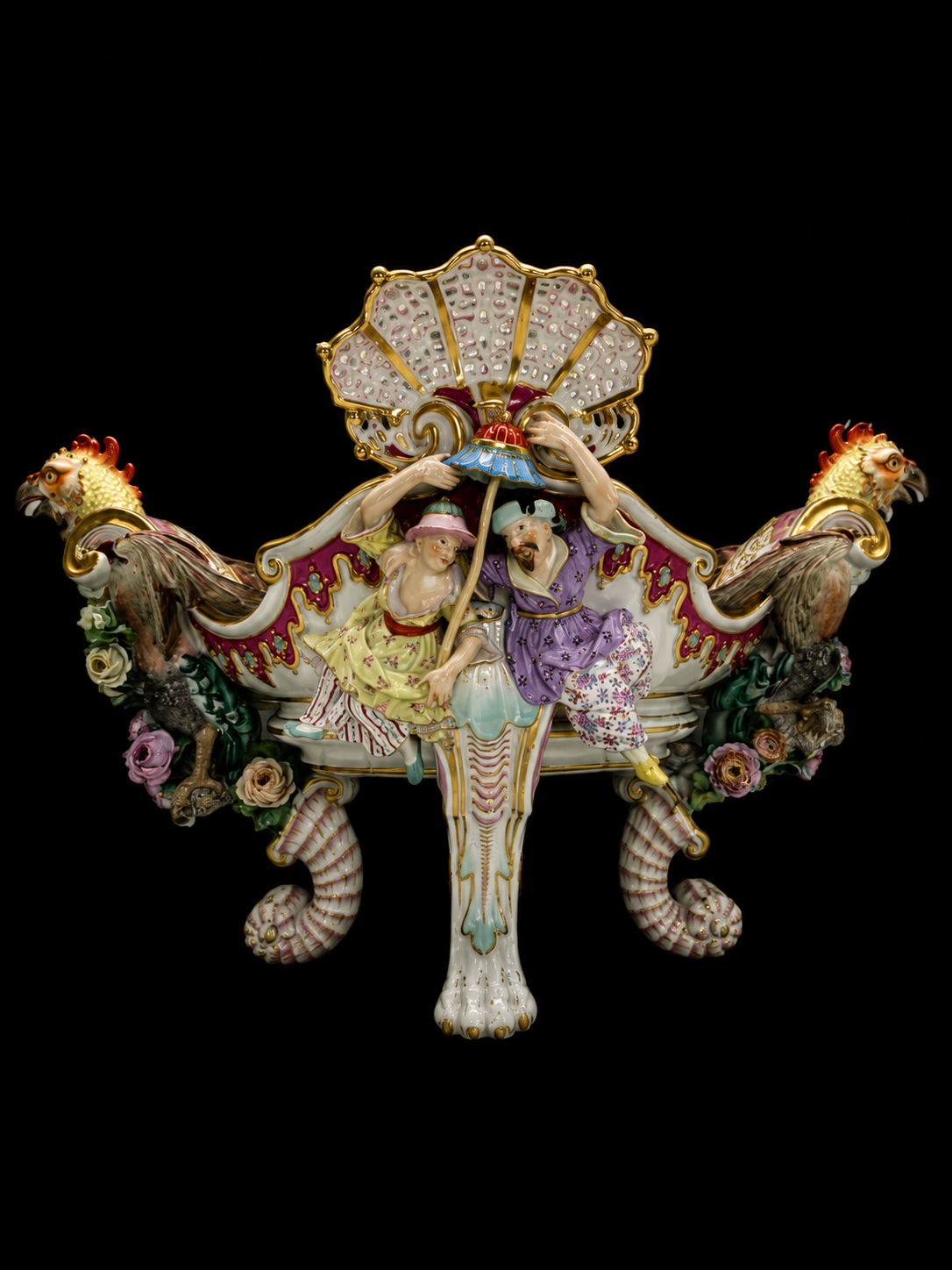
19th century, marked with blue crossed swords after a model by Johann Joachim Kaendler (1737) produced for Count Bruhl, gilt and painted in colours, the deep shaped oval bowl moulded to the outside with bosses and meandering ornaments, applied to the front and the back with an Oriental bearded man, wearing a hat and flower-enhanced attire, holding his right hand around the shoulders of an Oriental lady, wearing a yellow hat and holding an umbrella, surmounted by a large pierced shell, the left and the right applied with a model of a large rooster perched on a flowering branch, raised on two scroll and two paw feet 55.8cm. wide, 33cm. high
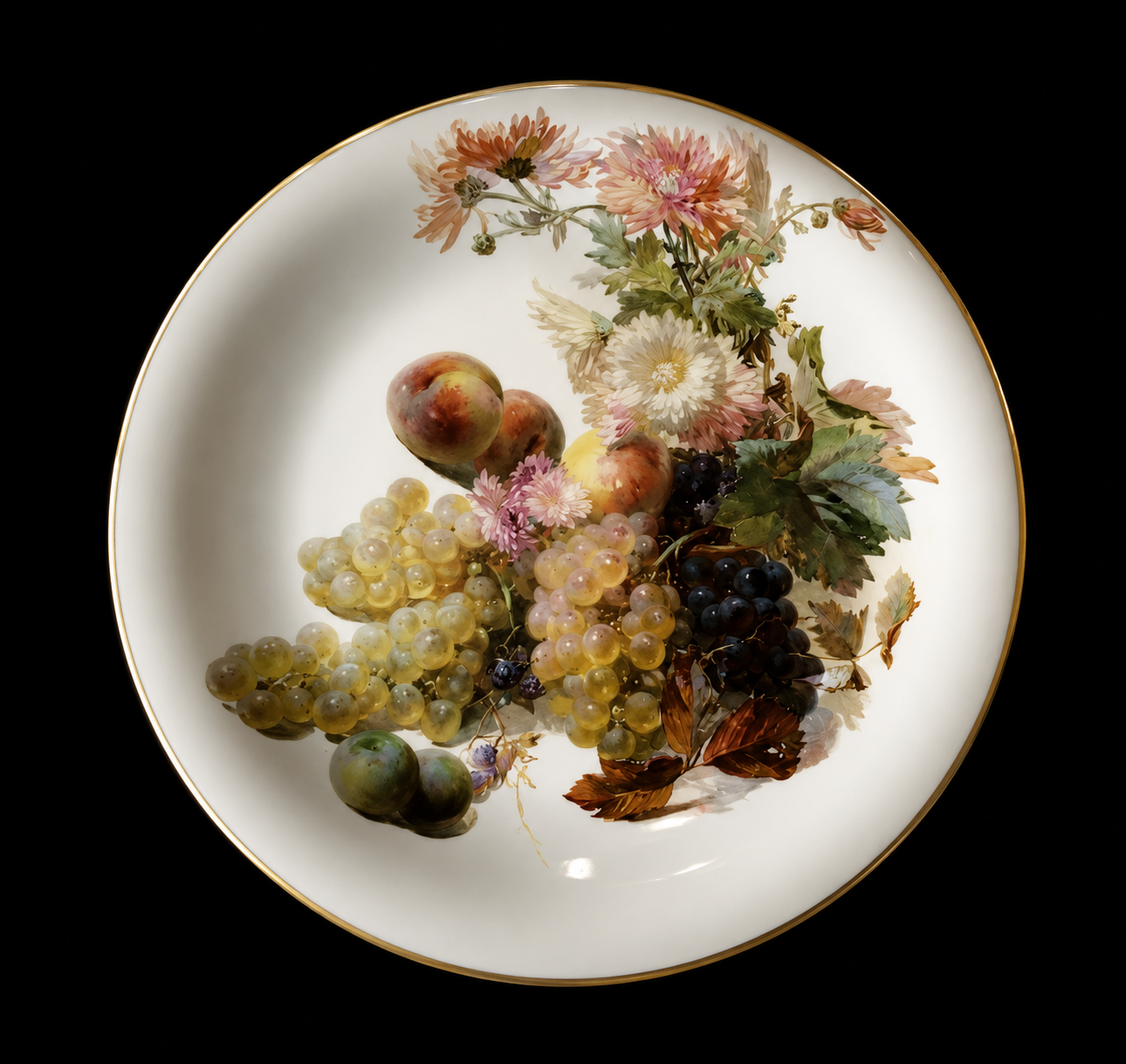
Magnificent Meissen Porcelain Charger
Intricately painted with a fruit still life representing spring; the lush spring bouquet of green grapes, sprays of hydrangea, peaches, and plums.
Blue crossed sword mark, impressed on back "130" WG.
Late 19th Century.
Diameter 18 1/2 inches
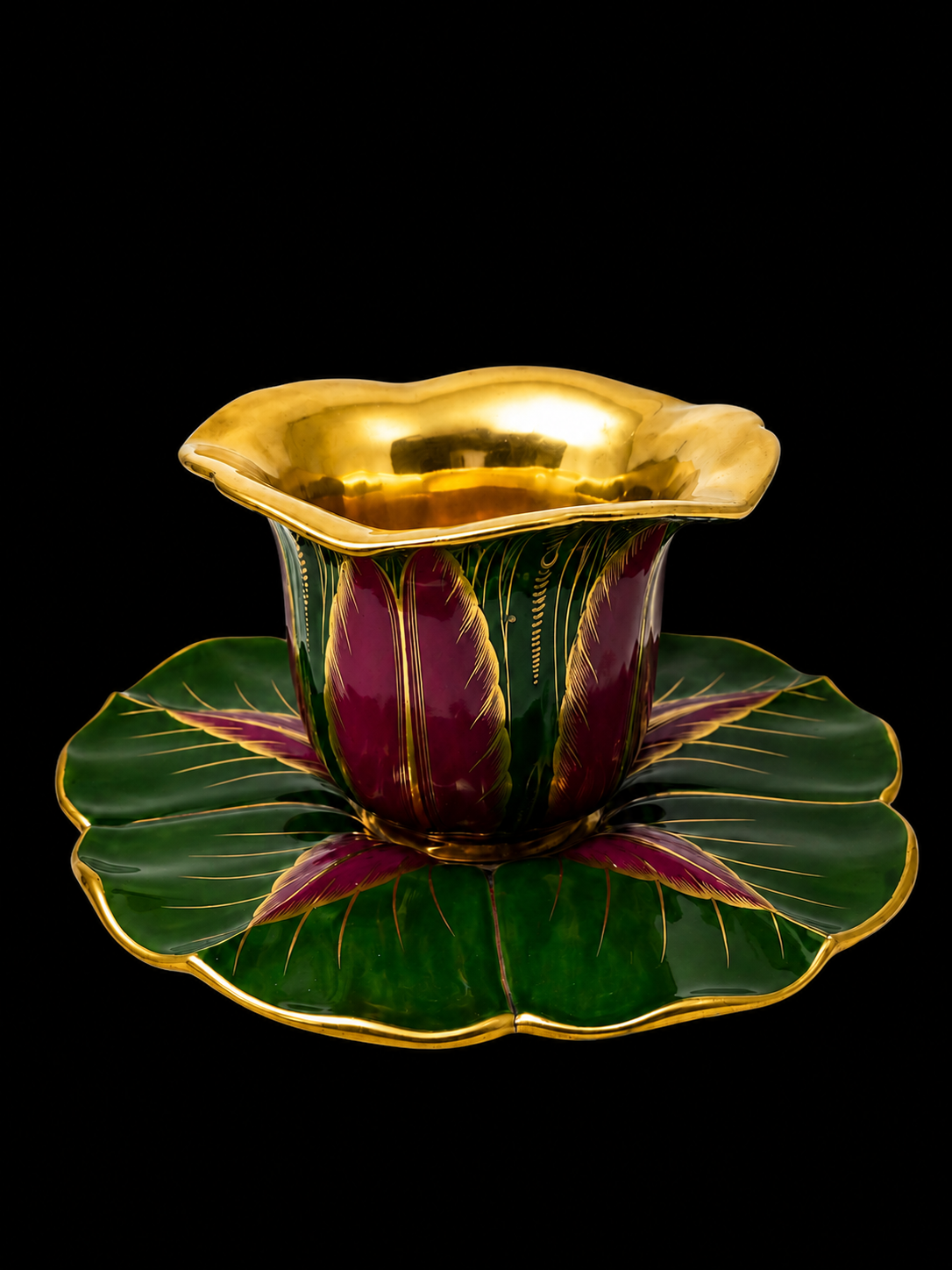
The cup and saucer formed as bell-shape cobaea blossom, painted in purple and green and enriched in gilt, the underside with blue stencilled interlaced Ls enclosing Sevres fleur-de-lys mark, the saucer incised 'M', with the following gilded marks: gilder's mark 'MC', cypher 'EZ', dated '1 Julliet 1814'.Dimensions: Cup 6.5cm high x 8.5cm diameter Saucer 13cm diameter
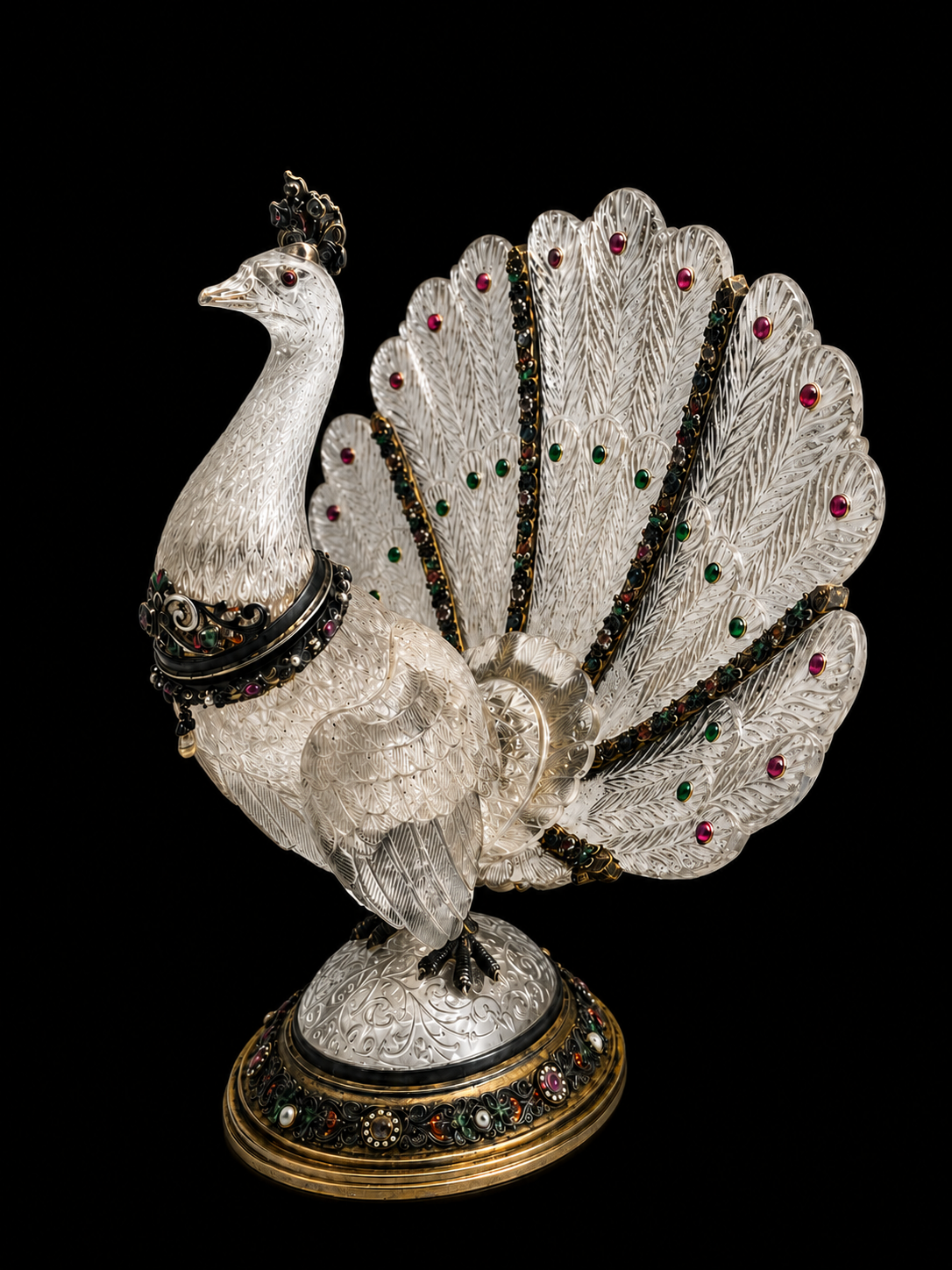
A Viennese gem-set silver-gilt, enamel and rock crystal peacock. Circa 1880His tail fully displayed, with a hinged neck, on an oval domed base, on a stepped plinth 10 in. (26 cm.) high
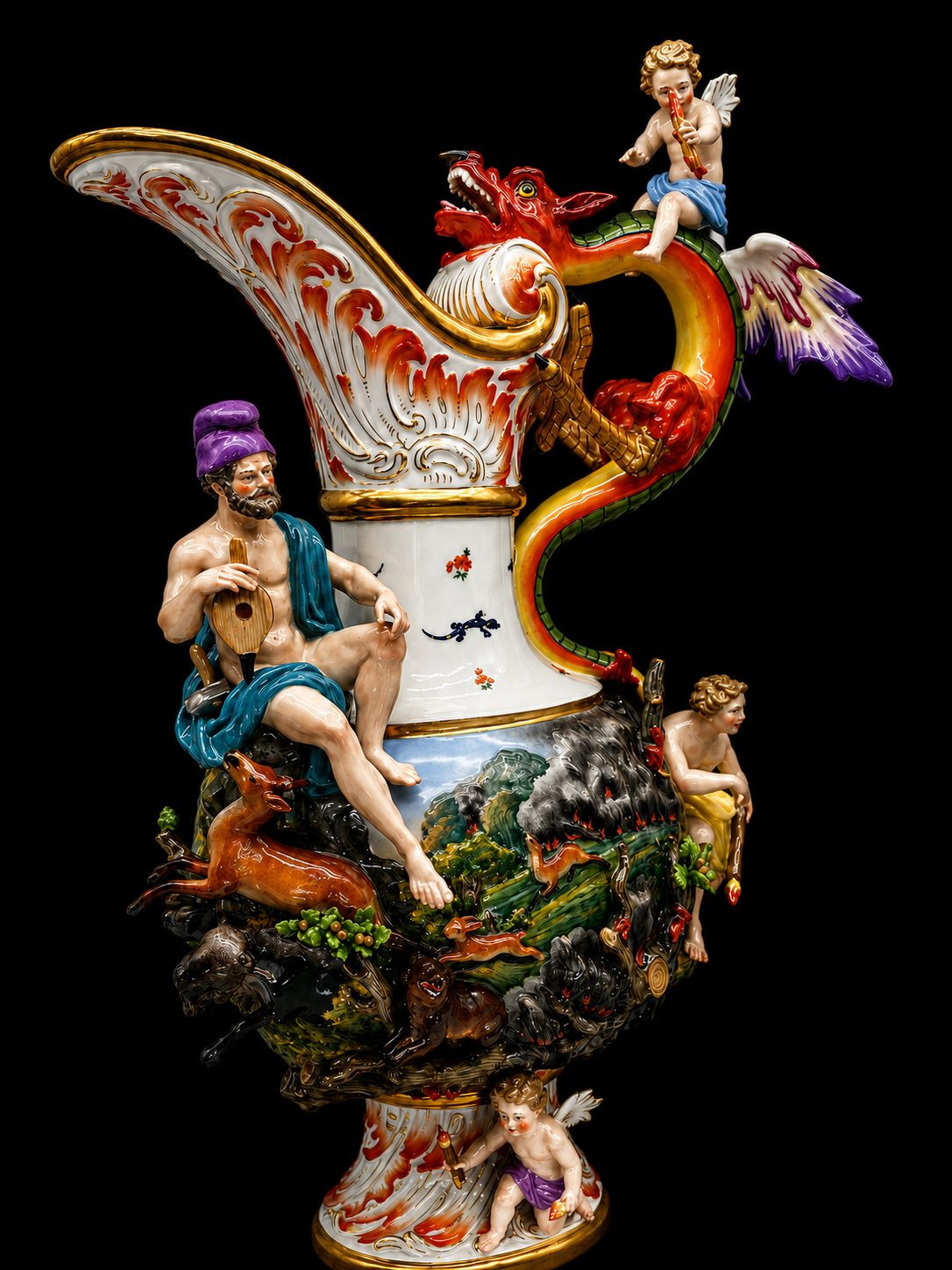
A MEISSEN PORCELAIN EWER EMBLEMATIC OF FIRE LATE 19TH CENTURY, BLUE CROSSED SWORDS MARK, INCISED MODEL NO. 310., PRESSNUMMER 147, AFTER THE MODEL BY J.J. KAENDLER Of flattened baluster form with dragon handle, the body molded in relief with an erupting volcano and wild animals escaping from a forest fire, a figure of Vulcan carrying bellows seated on the shoulder and a woman applied to the side, the foot with a putto carrying flames 25 in. (66.2 cm.) high
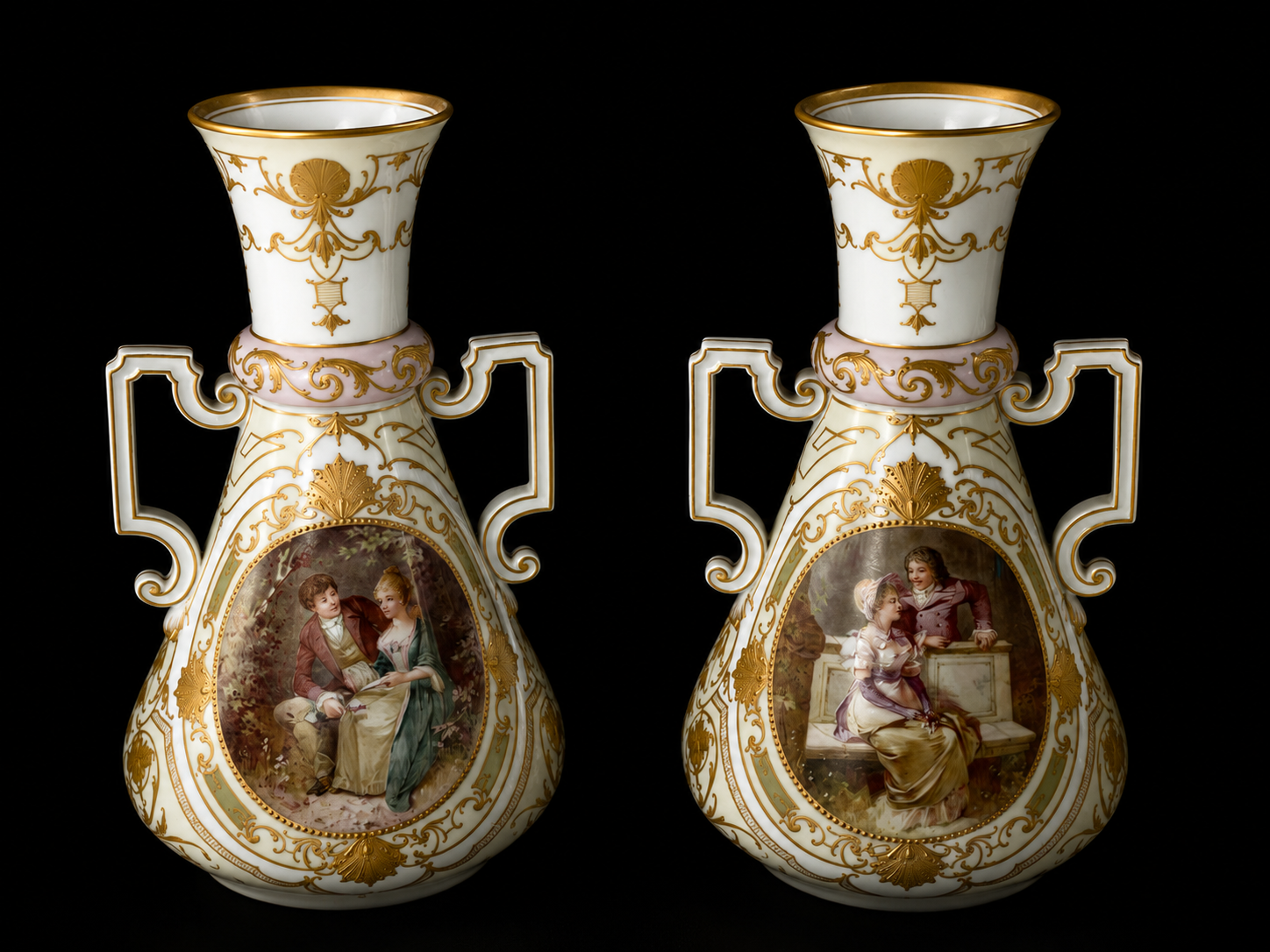
PAIR KPM 19th CENTURY HANDLED VASES HP PORTRAIT LOVERS WITH FLOWERS GOLD GILT BERLIN ANTIQUEFirst quality KPM blue scepter and red orb mark
Measure approximately 10-1/4” high x approximately 5” wide across handles
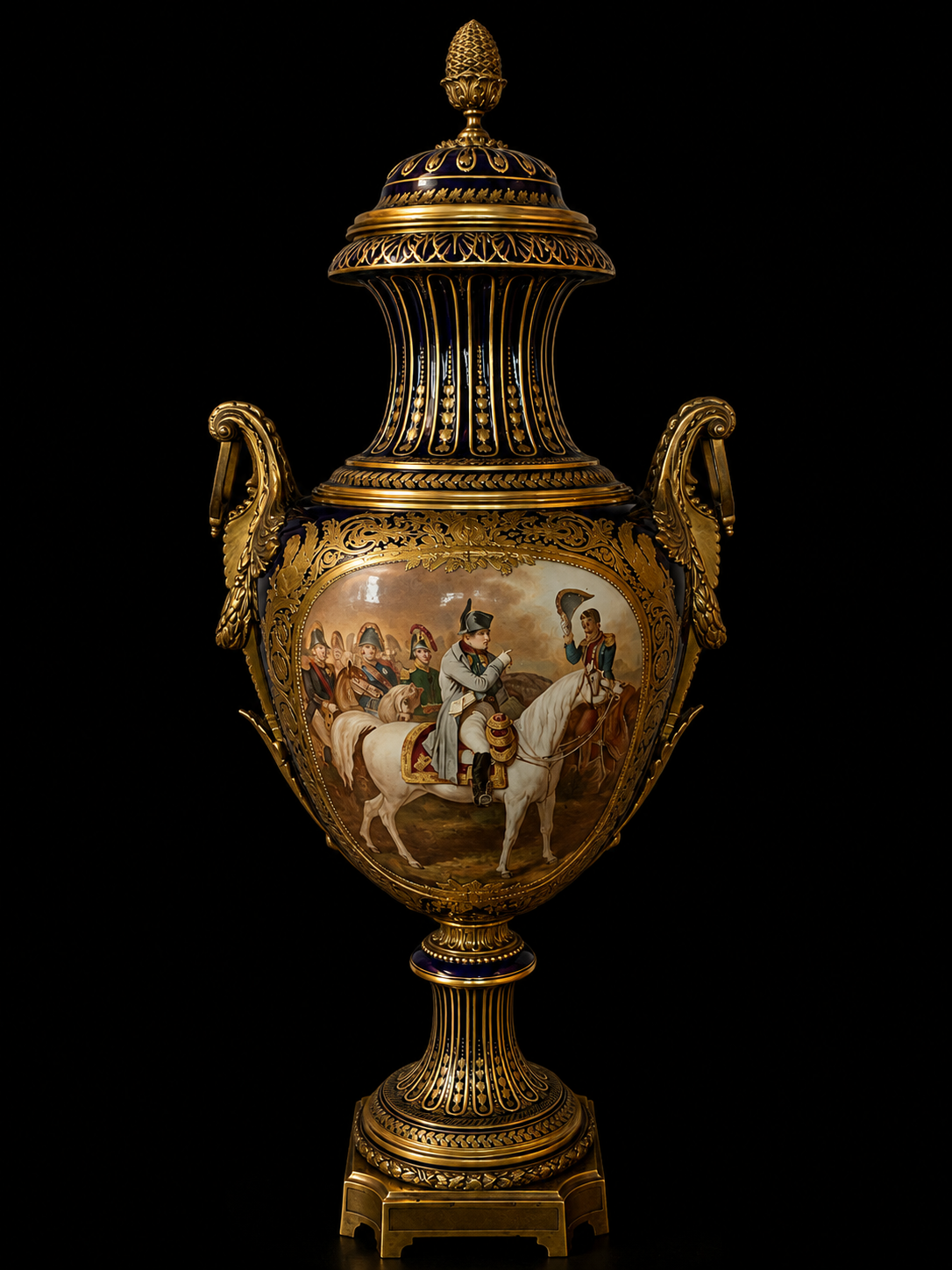
AN ORMOLU-MOUNTED SEVRES PORCELAIN NAPOLEONIC COBALT-BLUE GROUND VASE AND COVER EARLY 19TH CENTURY, depicting soiree L'Austerlitz and Fountaine Peau, Marked M. Imples Sevres, gifting by Princess Borghese to Napoloeon's brother in law Prince Murat. Prince Murat is a French princely title that traces its origin back to 1804, when Emperor Napoleon granted the rank of prince français to his brother-in-law Joachim Murat, who subsequently reigned as King of Naples from 1808 to 1815.[1] On 5 December 1812, Joachim Murat's second son Lucien was created sovereign Prince of Pontecorvo (an enclave in the Kingdom of Naples) in succession to Jean-Baptiste Jules Bernadotte, by an Imperial Decree. SIGNED Ineligibly Poitevin SEVRES Of baluster form, the domed cover gilt w 46 in. high
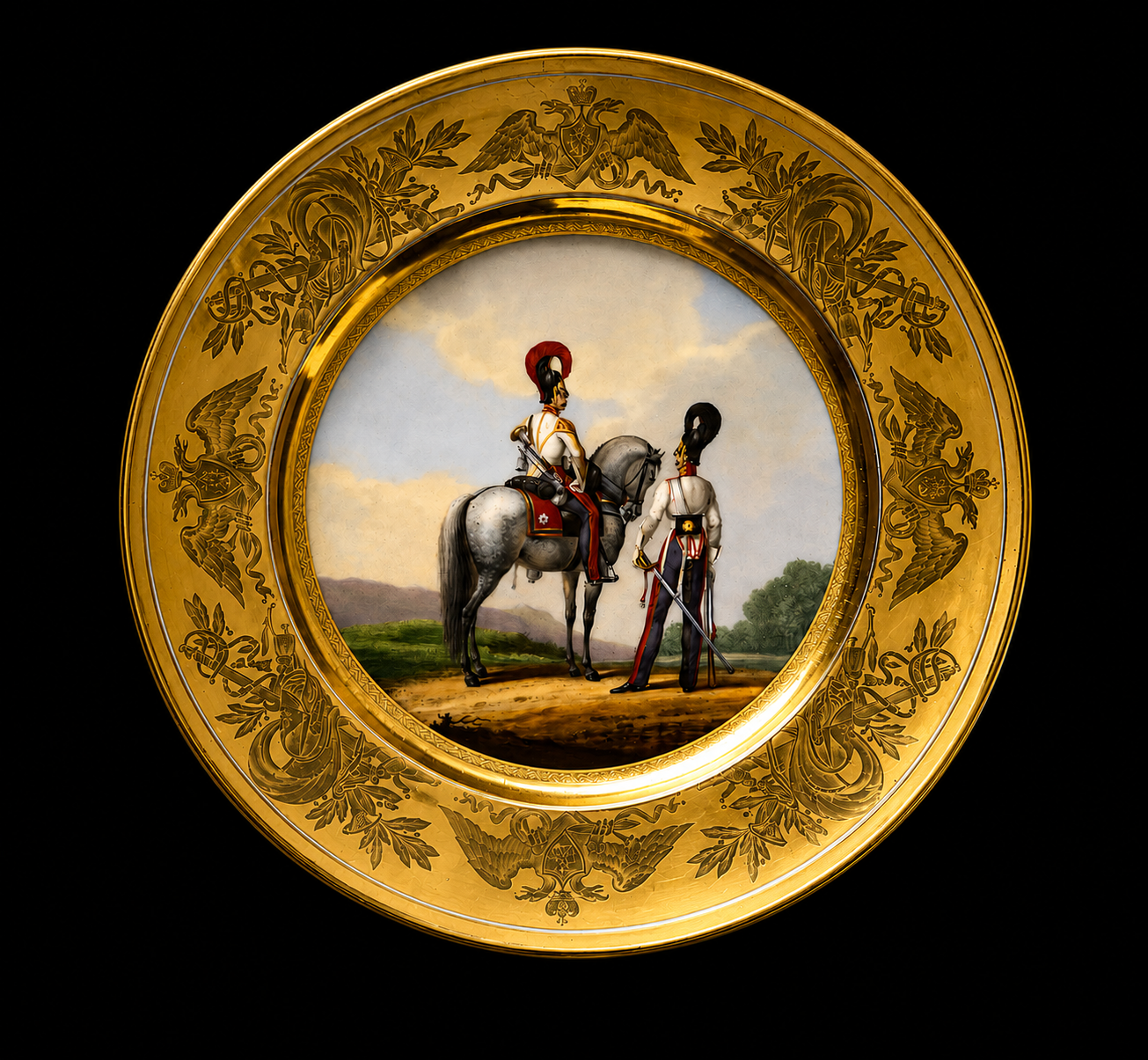
An impressive and richly decorated porcelain plate centered by a finely painted military scene depicting a mounted cavalry officer upon a gray horse accompanied by a standing soldier, set within an expansive landscape beneath a dramatic cloudy sky. The exceptionally elaborate gilt border is ornamented with military trophies, including standards, weapons, armor and Imperial motifs, prominently incorporating the crowned Russian double-headed eagle.
The broad gilt rim is further enriched with finely detailed engraved and tooled decoration, creating a striking frame for the central composition. The combination of military iconography, extensive gilding and Imperial symbolism gives the plate a particularly grand presentation character.
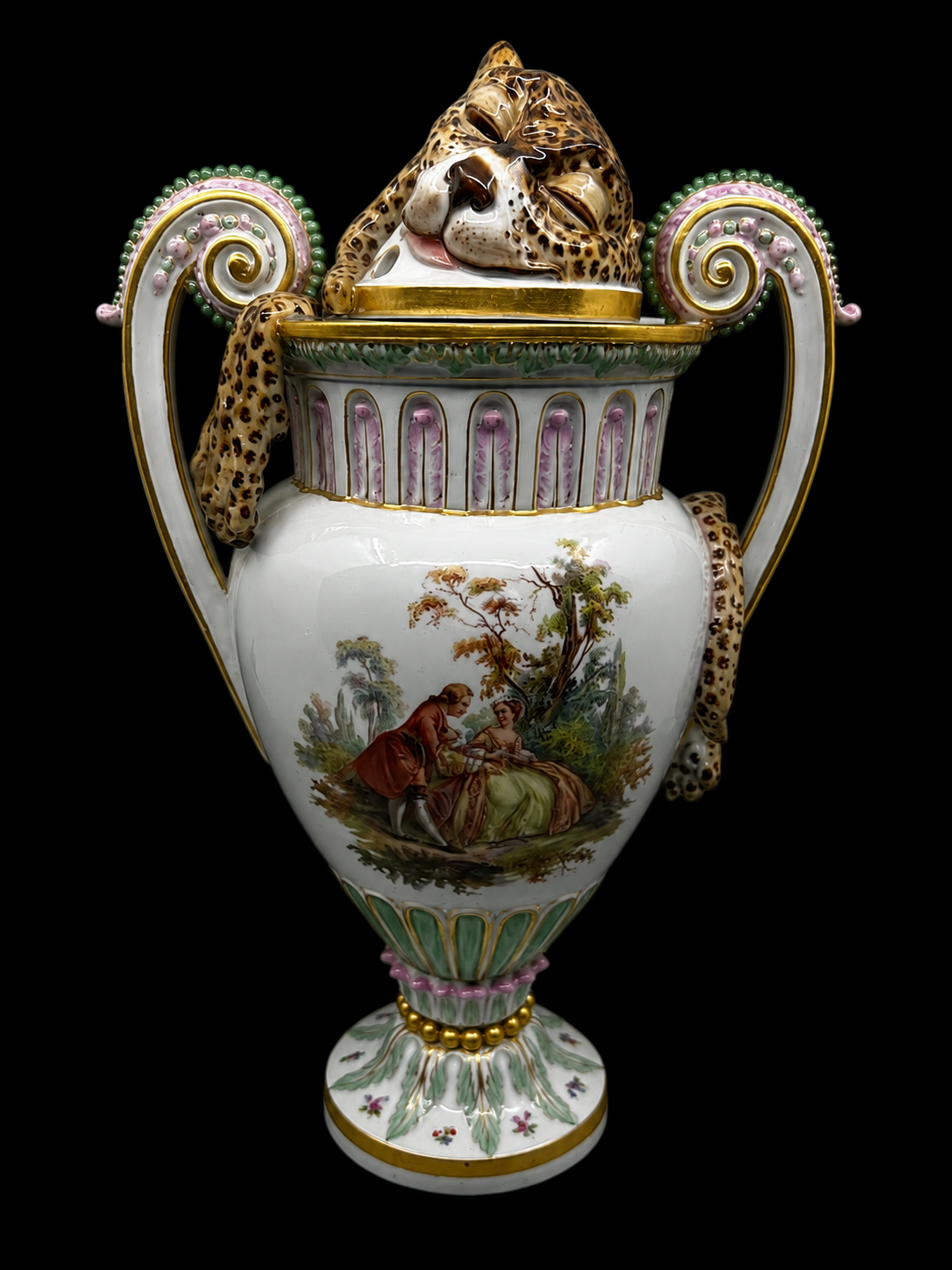
A Meissen Pot-Pourri Vase and Pierced Cover, 19th century the pierced cover and large part of the back modelled as a sculptural leopard skin, its claws hanging over the rim of the urns, the front painted with a pastoral scene of a woman and her companion, crossed swords mark in underglaze-blue, gilt numeral 8., incised model number g 48., impressed numeral 68 height 14 in.35.5 cm
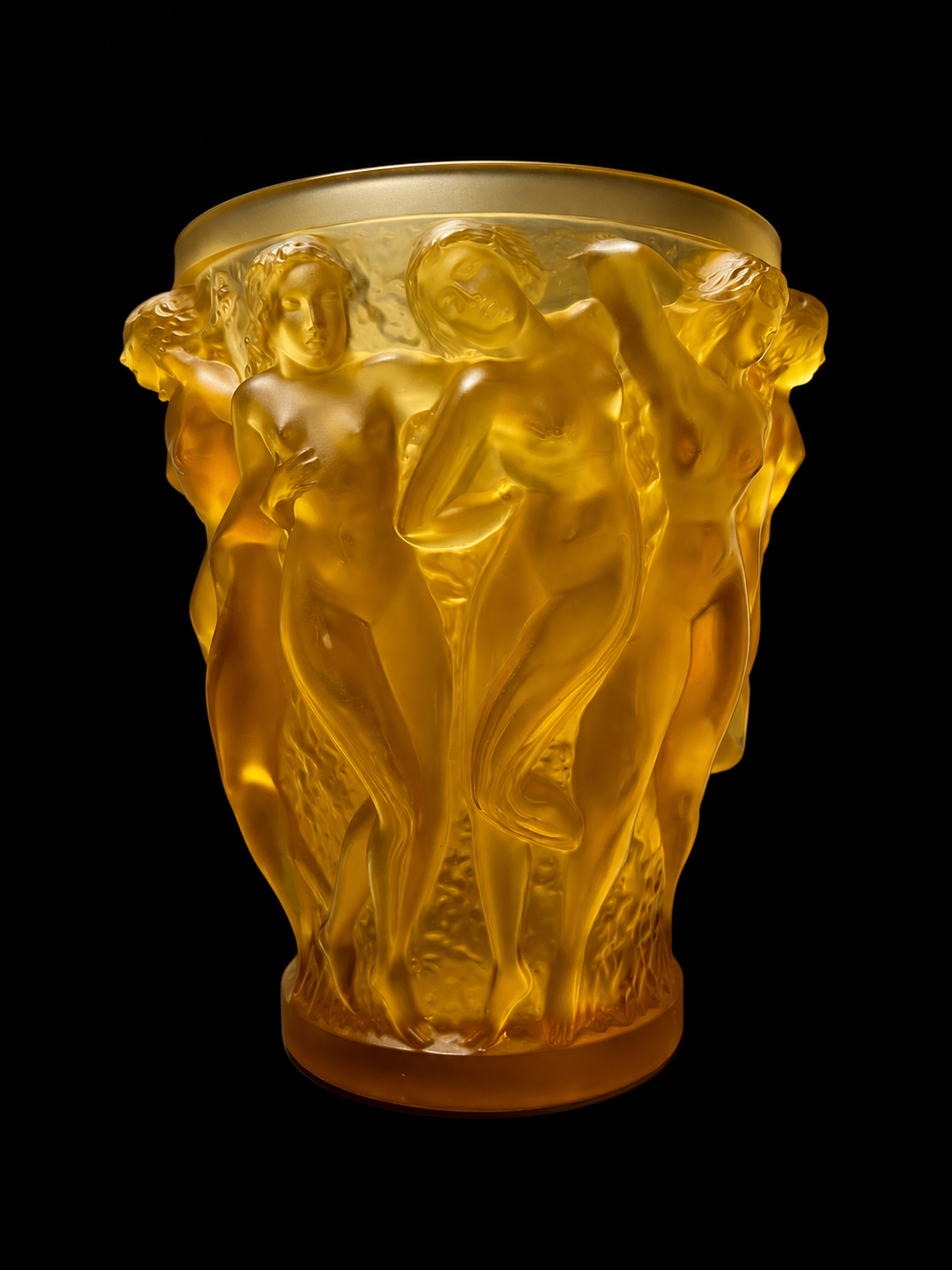
Limited Edition Lalique Amber Glass Bacchantes 2007 Anniversary Vase, 2007 Marks: Lalique France, 2343 9-5/8 inches (24.5 cm)
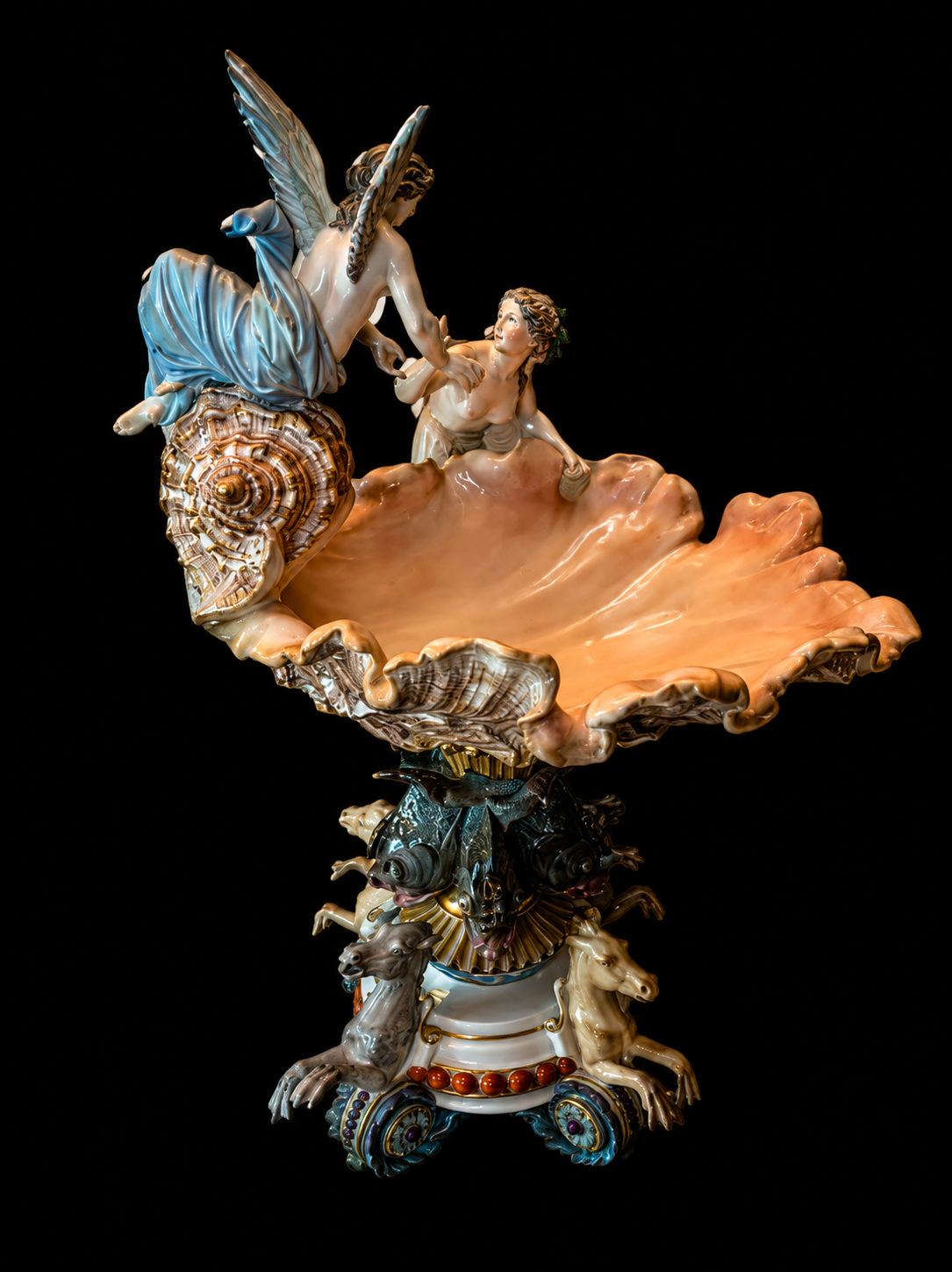
Monumental Meissen Mythological Centerpiece With Coat of Arms19th century, composed of a large oyster / conch shell bowl upon which are perched an angel and a nereid, the shell being supported by dolphin form standard above a circular plinth featuring four hippokampoi (the horses of Neptune), marked on the bottom with crossed blue swords and with raised mark "C163". Austrian Coat or Arms 26 x 12.5 x 17 in.
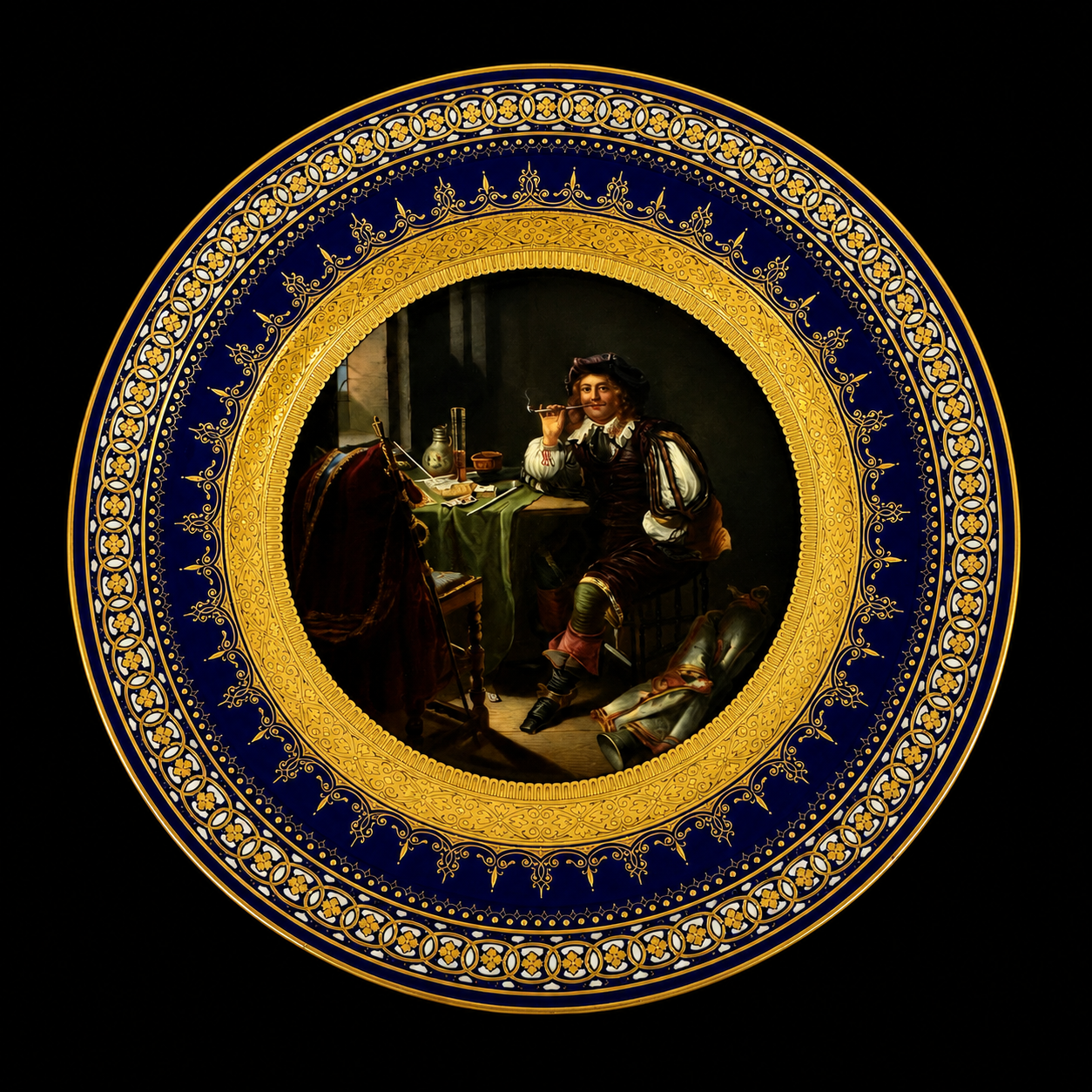
Circa 1860.Finely painted with a detailed copy of an Old Master painting, Der Trompeter after Franz van Mieris, the finely-dressed musician resting by a table and smoking a pipe, his instrument and regalia by his side, the deep blue border pierced and elaborately gilded, 24cm diam, crossed swords mark in underglaze blue, title of subject in black script
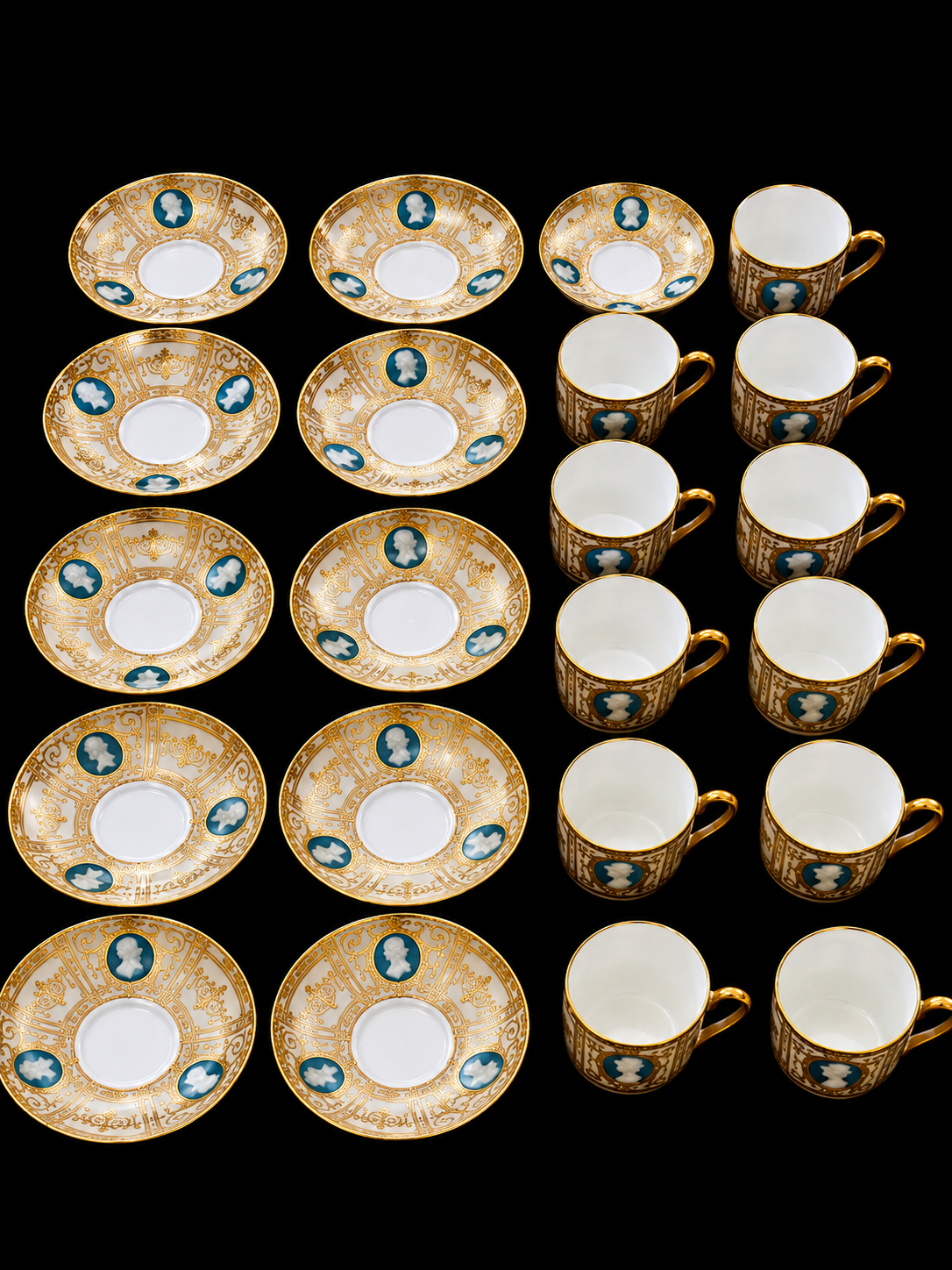
MINTONS PATE-SUR-PATE CUPS AND SAUCERS, DECORATED BY ALBION BIRKS early 20th Century, with gilt printed factory mark and illegible date cipher, retailed by Tiffany & Co., New York, white ground with cream colored panels centering blue ground pate-sur-pate portrait medallions, the cup having one signed Birks, the other signed AB, the complementary saucer with three medallions, each signed AB, h: (of cup) 2.25 in., dia: (of saucer) 4 7/8 in. (2)
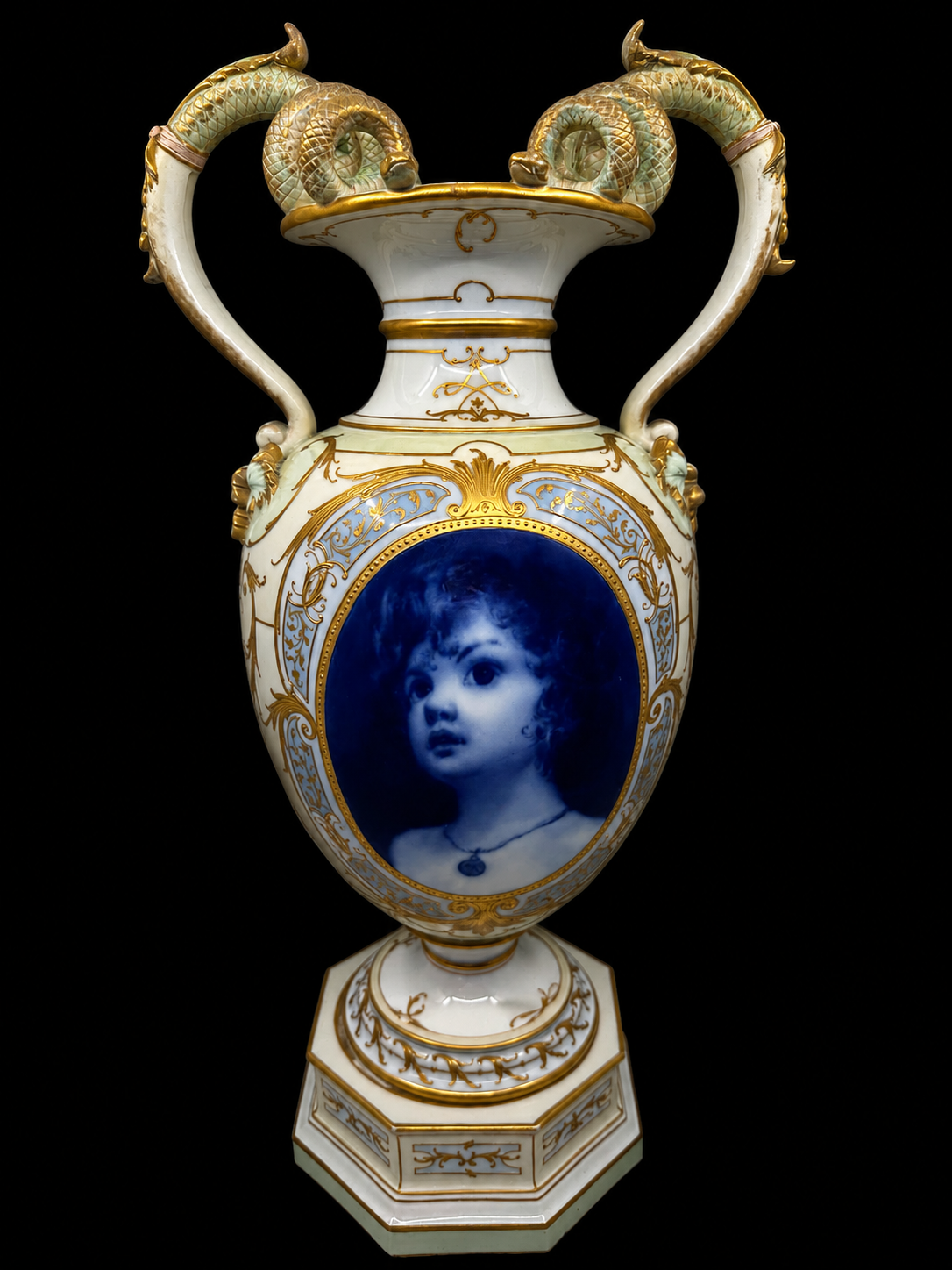
LARGE HAND PAINTED KPM , BERLIN WEICHMALEREI SOFT PASTE PAINTED PORCELAIN SNAKE HANDLE VASE WITH COBALT PORTRAIT OF YOUNG GIRL MEDALLION SURROUNDED BY GOLD DECORATIONS & FLOWERS INVERSO , WITH FINE SNAKE HANDLES - 10" x 6" x 18" high
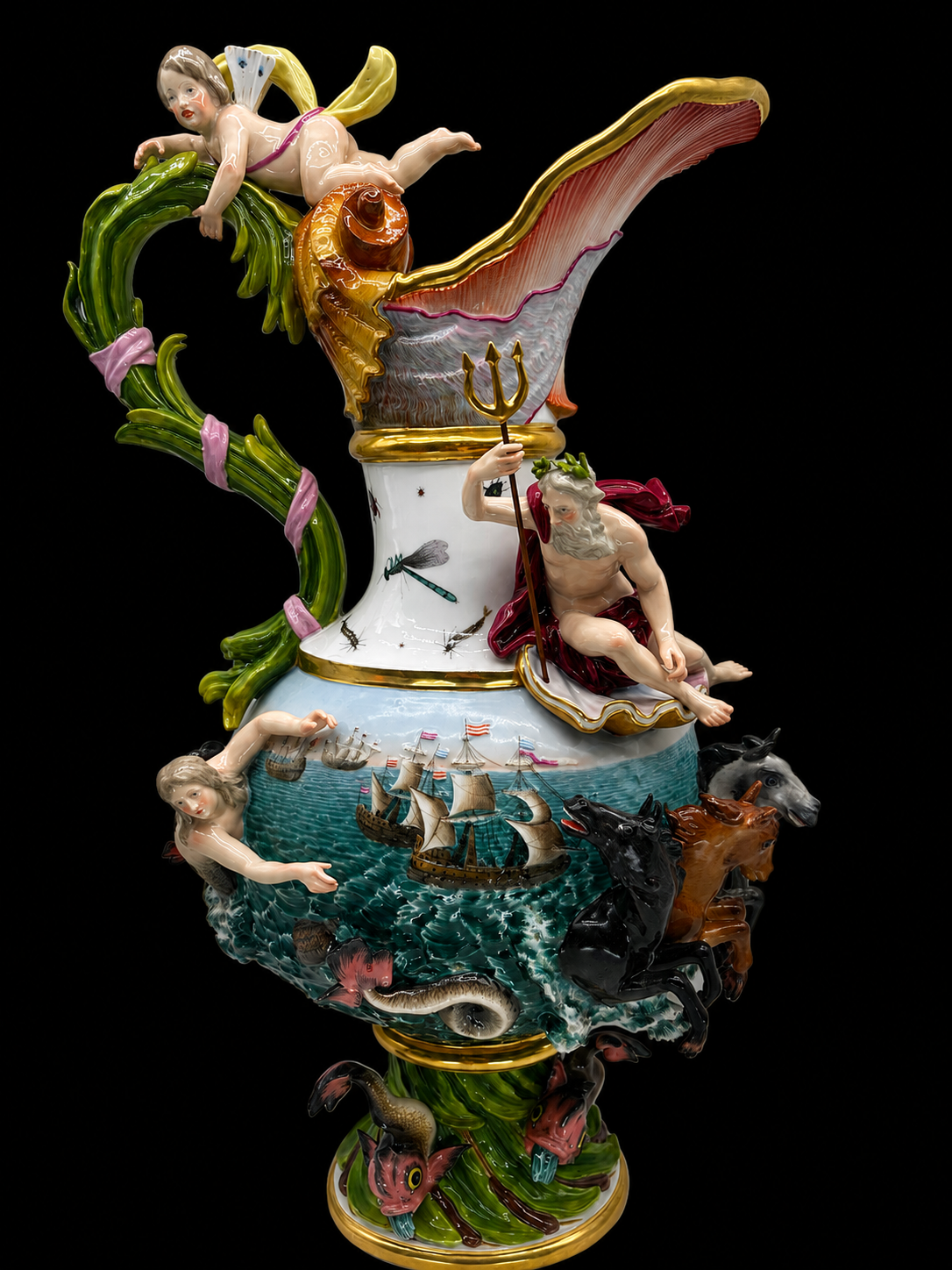
The scroll handle formed as ribbon-tied aquatic leaves surmounted by a putto, the neck painted with dragonflies and other insects, the body molded with a fleet of war ships between a figure of a mermaid and hippocampi, Neptune above, the base with two dolphins among bulrushes 25 1/4 in. (64.2 cm.) high.Excellent condition, no damage, no chips.
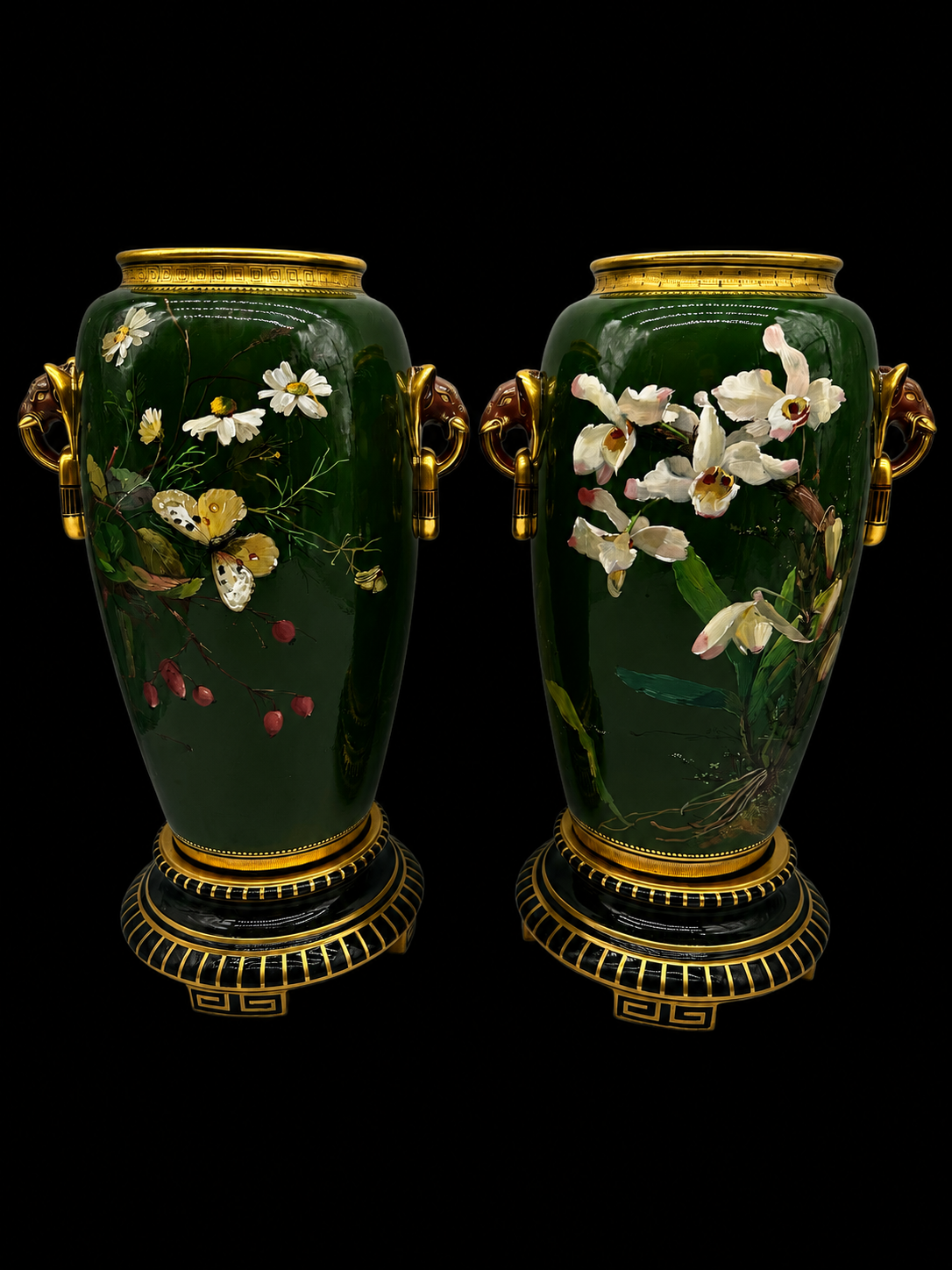
date code for 1876 Flanked by stylized elephant and ring handles, decorated with flora and butterflies, one signed R. Pilsbury, on circular foot, impressed MINTONS, date cypher and 1744, gold painted MINTONS 1880, raised on original Mintons pedestals. Foot notes Richard Pilsbury (1830-1897) was one of Minton's leading artists, specializing in flower painting. Previous to his position at Minton, he apprenticed with Samuel Alcock & Co. and was an instructor at the National School of Design at Marlborough House. Whilst at Minton, Pilsbury's work was included in numerous international exhibitions. The scale of the present lot suggests the pair were probably exhibition pieces. overall height 18" inches
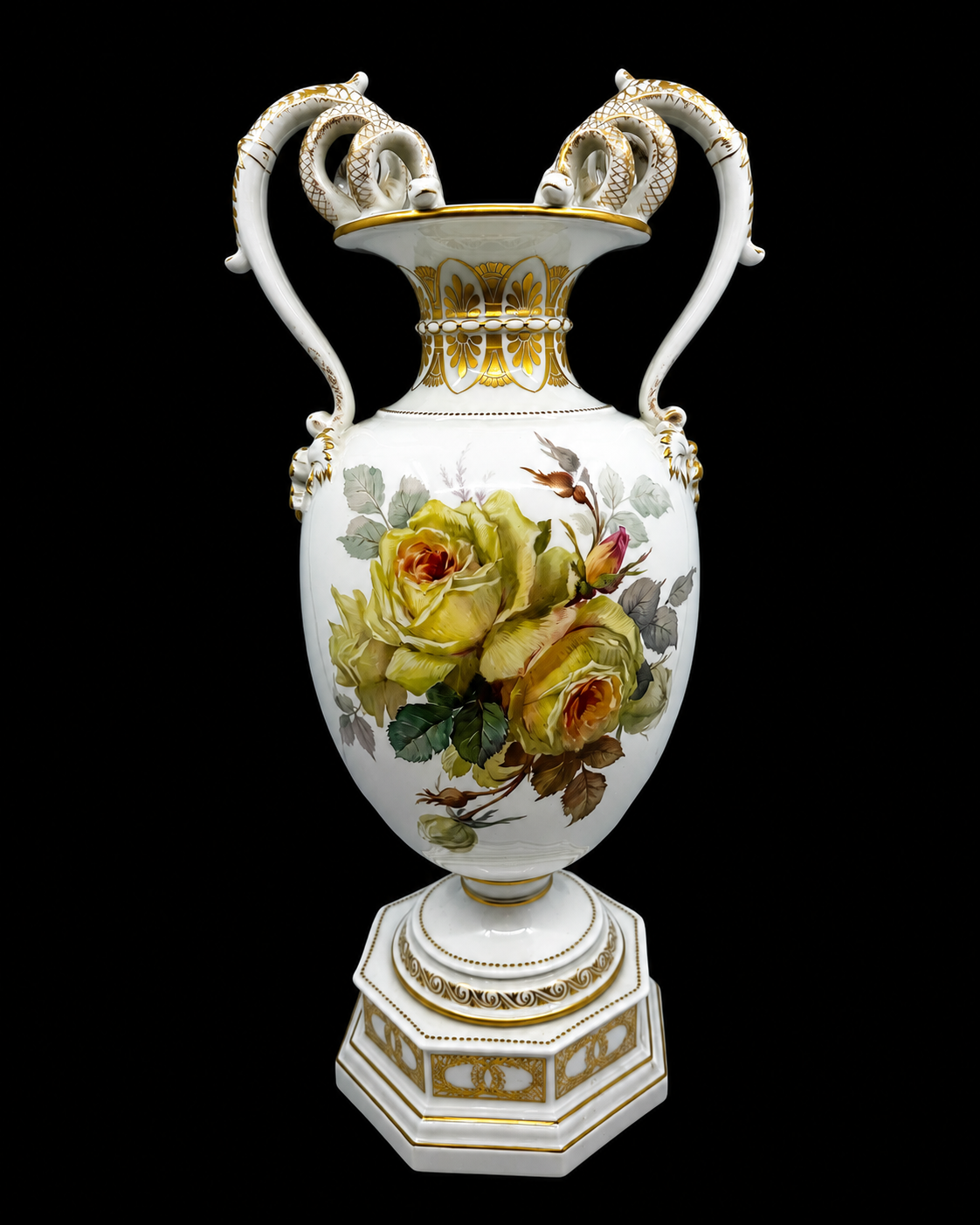
KPM weichmalerie vase with snakes and roses 15.5 inches tall The Royal Porcelain Factory in Berlin (German: Konigliche Porzellan-Manufaktur, abbreviated as KPM), also known as the Royal Porcelain Manufactory Berlin and whose products are generally called Berlin porcelain, was founded in 1763 by King Frederick II of Prussia (known as Frederick the Great). Its actual origins, however, lie in three private enterprises which, under crown patronage, were trying to establish the production of "white gold" (i.e. porcelain) in Berlin from the mid-18th century onwards.The company logo is a cobalt blue sceptre, which is stamped (painted prior to 1837) on every piece. All painted pieces produced by KPM are signed by the painter. KPM is still producing to this day; each piece of dishware and decorative porcelain is entirely unique.KPM has produced a number of dishware forms and porcelain figurines throughout its history. Some forms have hardly changed their shape in over 200 years of production. Frederick the Great, who, as the owner, jokingly referred to himself as his own "best customer", was under the spell of the Rococo style during his life; a culmination of this artistic style can be seen in his castles.To this day, the most successful designs of the 1930s are the Urbino, Urania and Arkadia (originally a tea set designed in honor of KPM's 175th anniversary) created by Trude Petri. The Arkadia medallions were created by Siegmund Schutz and the Urania set (with the same basic form as the Arkadia) did not enter production until after the war, as was also the case with the Arkadia table set. Porcelain figurines of different styles corresponding to each era have always been created under the guidance of the master workshop, including the modern animal sculptures, such as the miniature Buddy Bear or the Knut Bear.
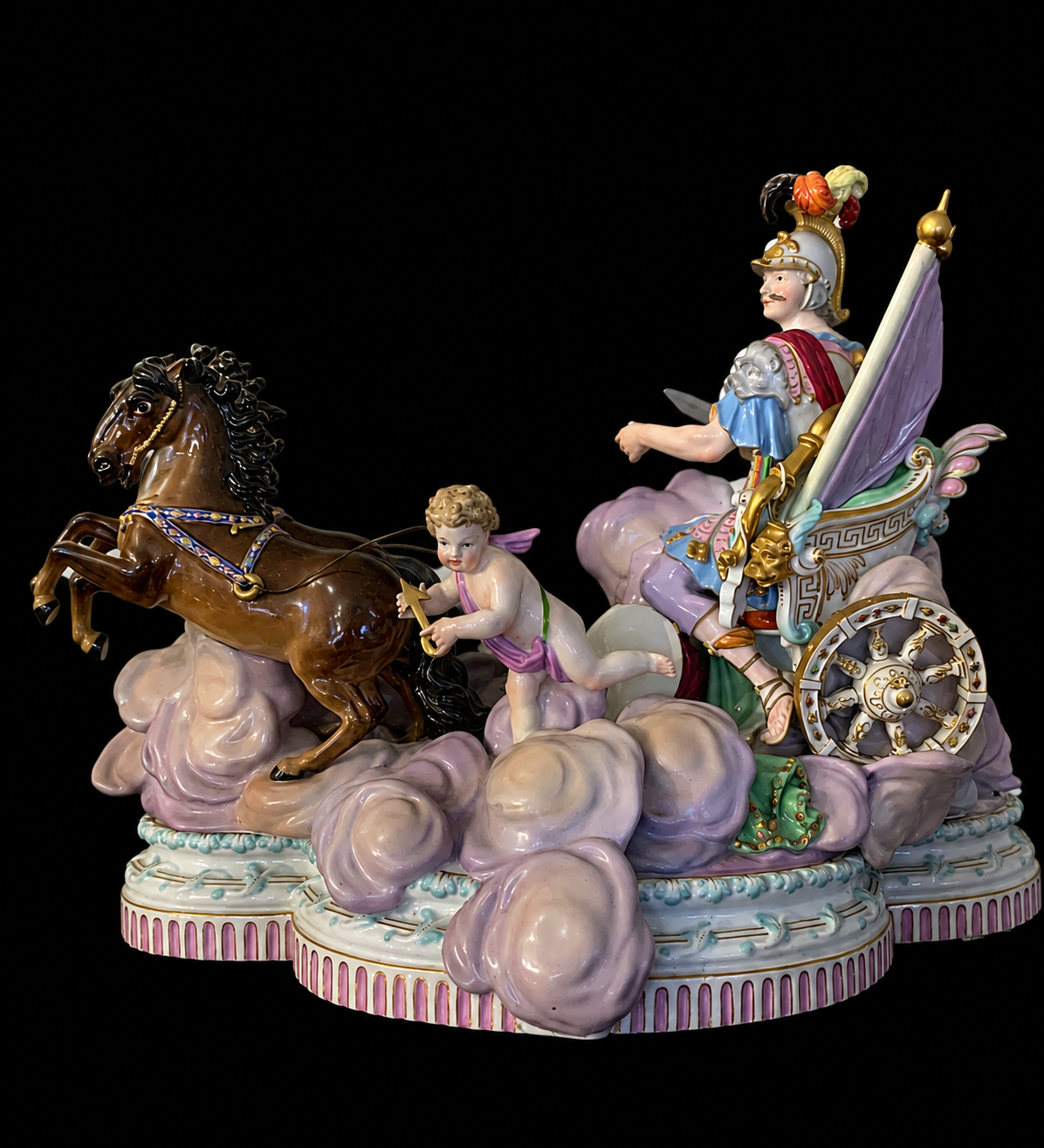
escription
A MEISSEN CHARIOT GROUP OF MARS,circa 1870, blue crossed swords marks, incised No. 22., impressed 137 and painted 29.,depicted as a Roman warrior seated in a chariot drawn by two rearing horses and attended by a putto amongst clouds, on a stepped scalloped base moulded with stiff-leaf tips, foliate entwined gilt ribbons and arches
17in. (45cm.) wide
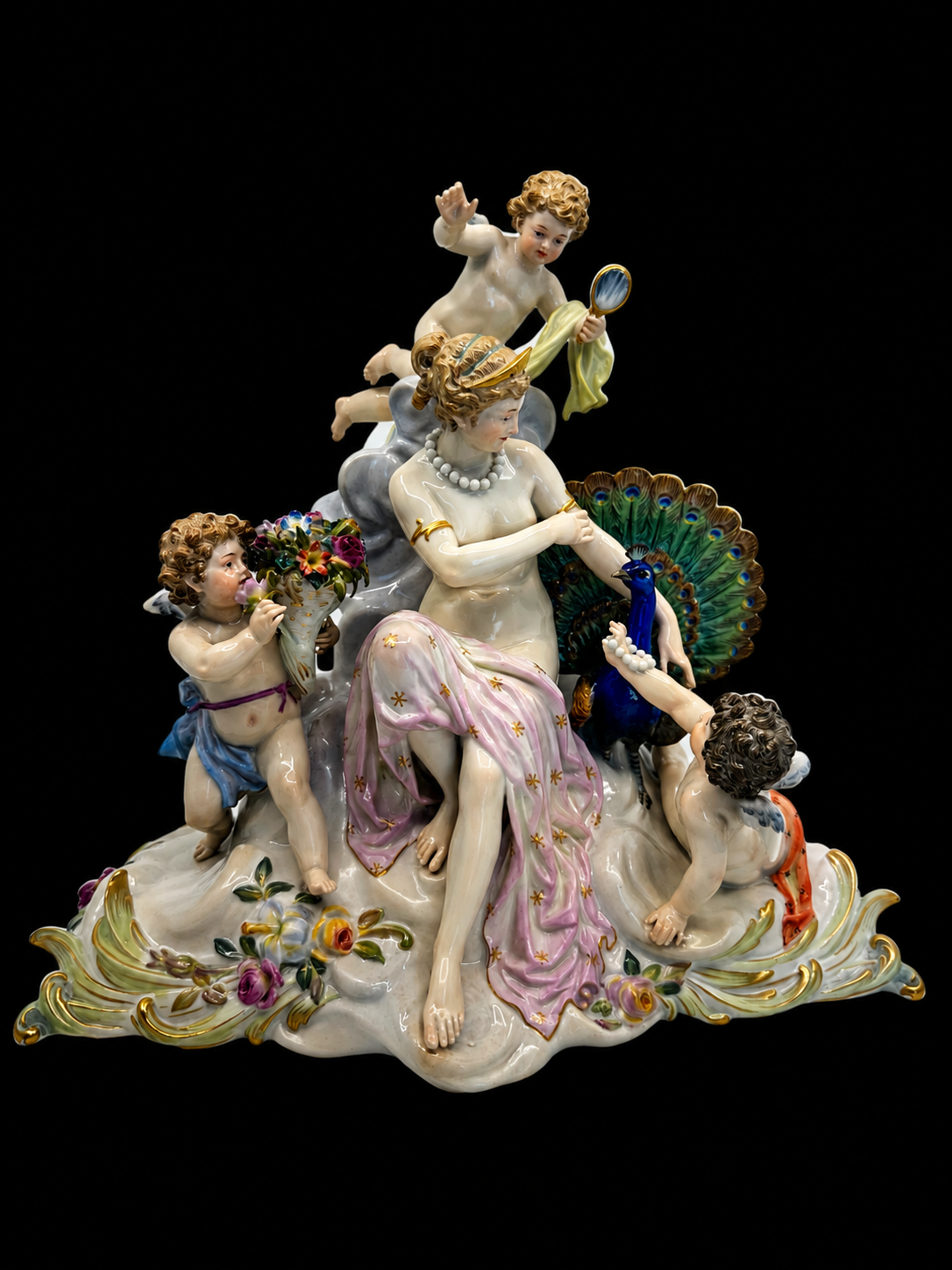
LATE 19TH CENTURY, BLUE CROSSED SWORDS MARK, INCISED O 199., IMPRESSED 125, PAINTED 69, AFTER THE MODEL BY T.P. HELMIG
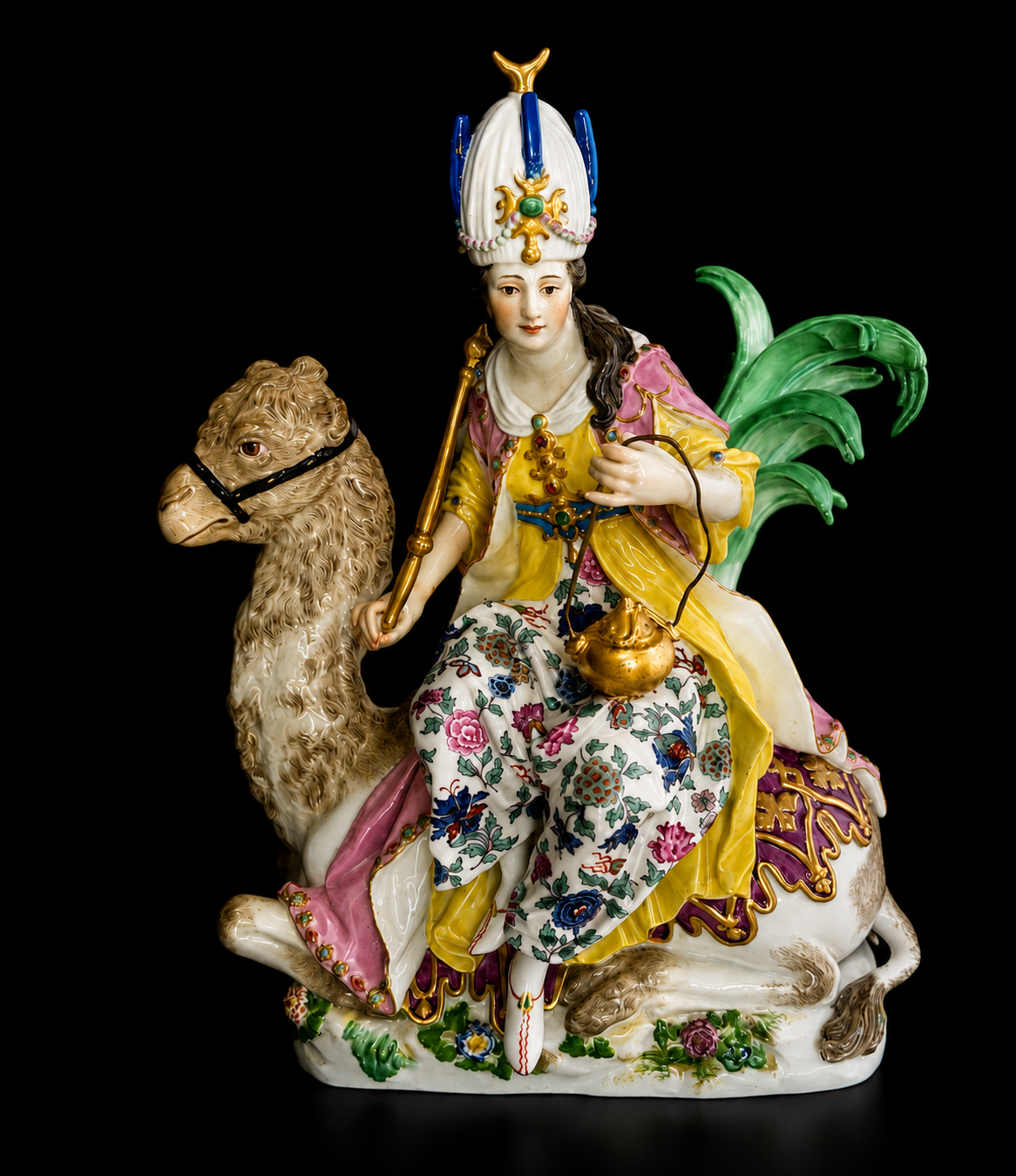
CIRCA 1745, SMALL BLUE CROSSED SWORDS MARK TO THE GLAZED INSIDE OF THE BASE, INSCRIBED 687
Modelled by J.J. Kaendler and J.F. Eberlein as an Oriental or Turkish lady seated on a recumbent caparisoned camel, wearing a jewelled white cloak and yellow tunic and a skirt enhanced with Indianische Blumen, her turban with pearls and feathers, in front of a palm-tree on rectangular base applied with flowers
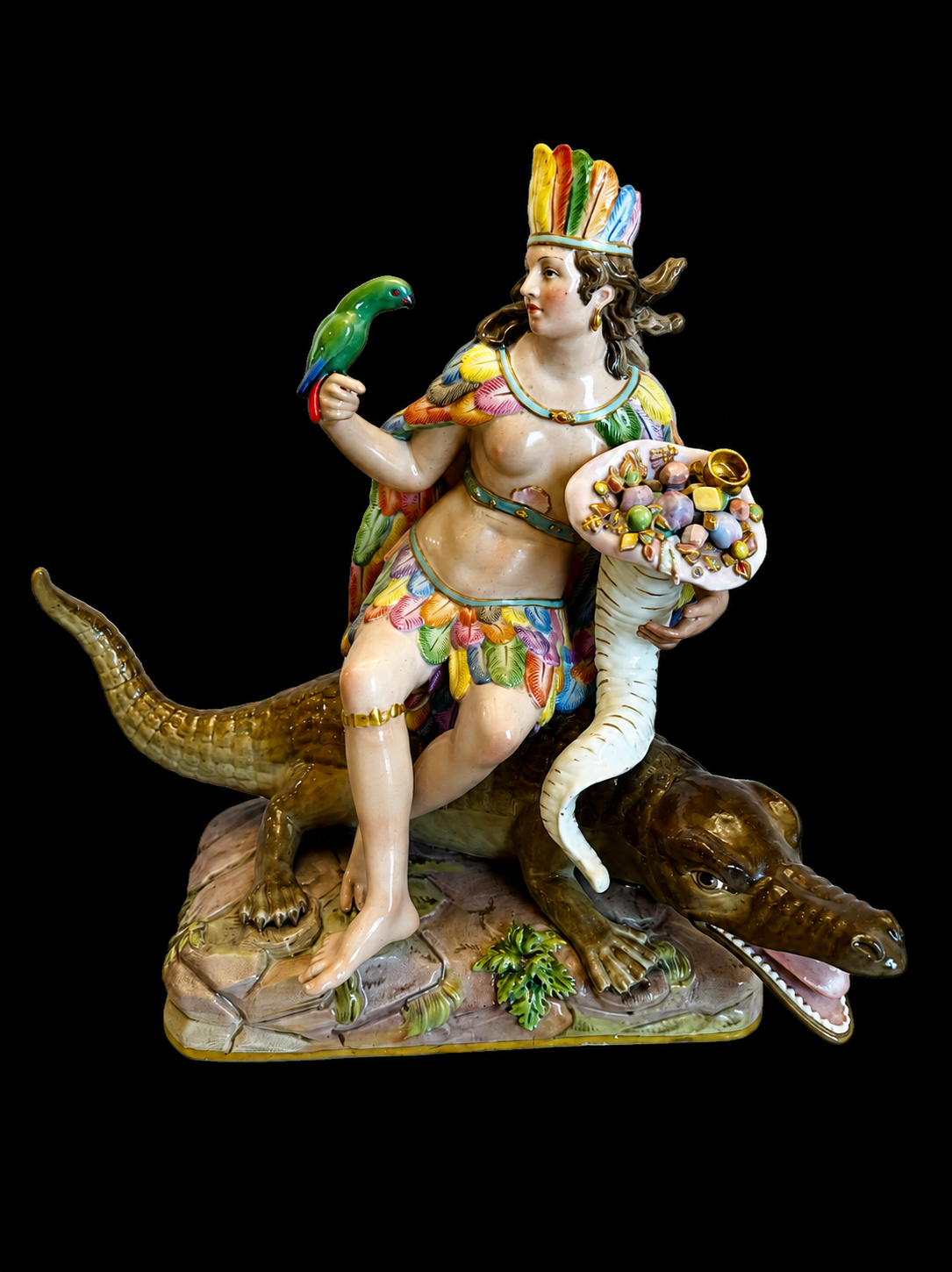
represented by a beauty dressed as an Indian clutching a cornucopia while seated upon an alligator. Marked with crossed swords mark in blue under glaze. 11.5" H x 12.5" W, Circa - Last quarter 19th C.
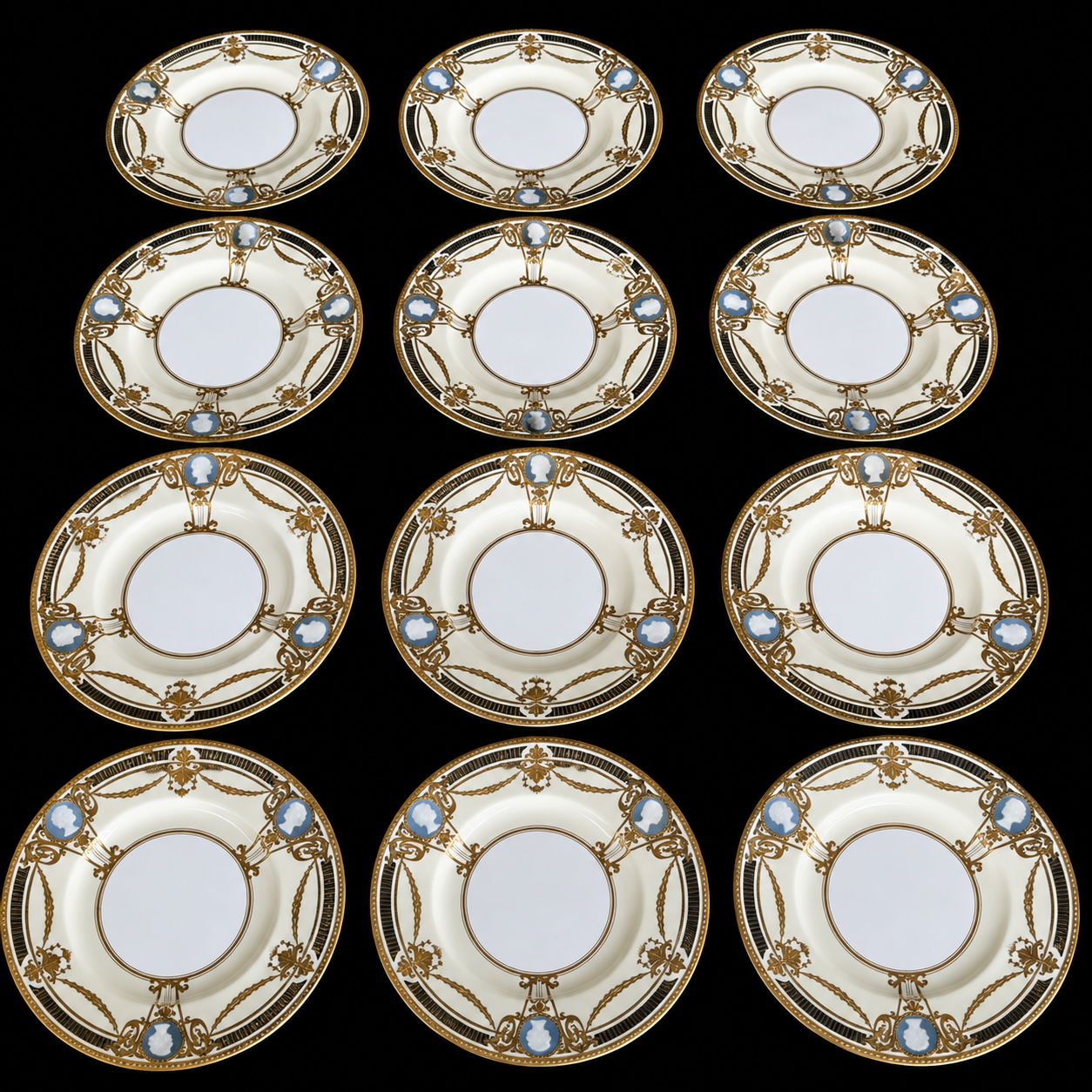
MINTONS PATE-SUR-PATE PLATES, DECORATED BY ALBION BIRKS early 20th Century, with gilt printed factory mark and illegible date cipher, retailed by Tiffany & Co., New York, white ground with cream colored panels centering blue ground pate-sur-pate portrait medallions, the cup having one signed Birks, the other signed AB, the complementary saucer with three medallions, each signed AB, dia: 9 7/8 in.
German, late 19th/early 20th century
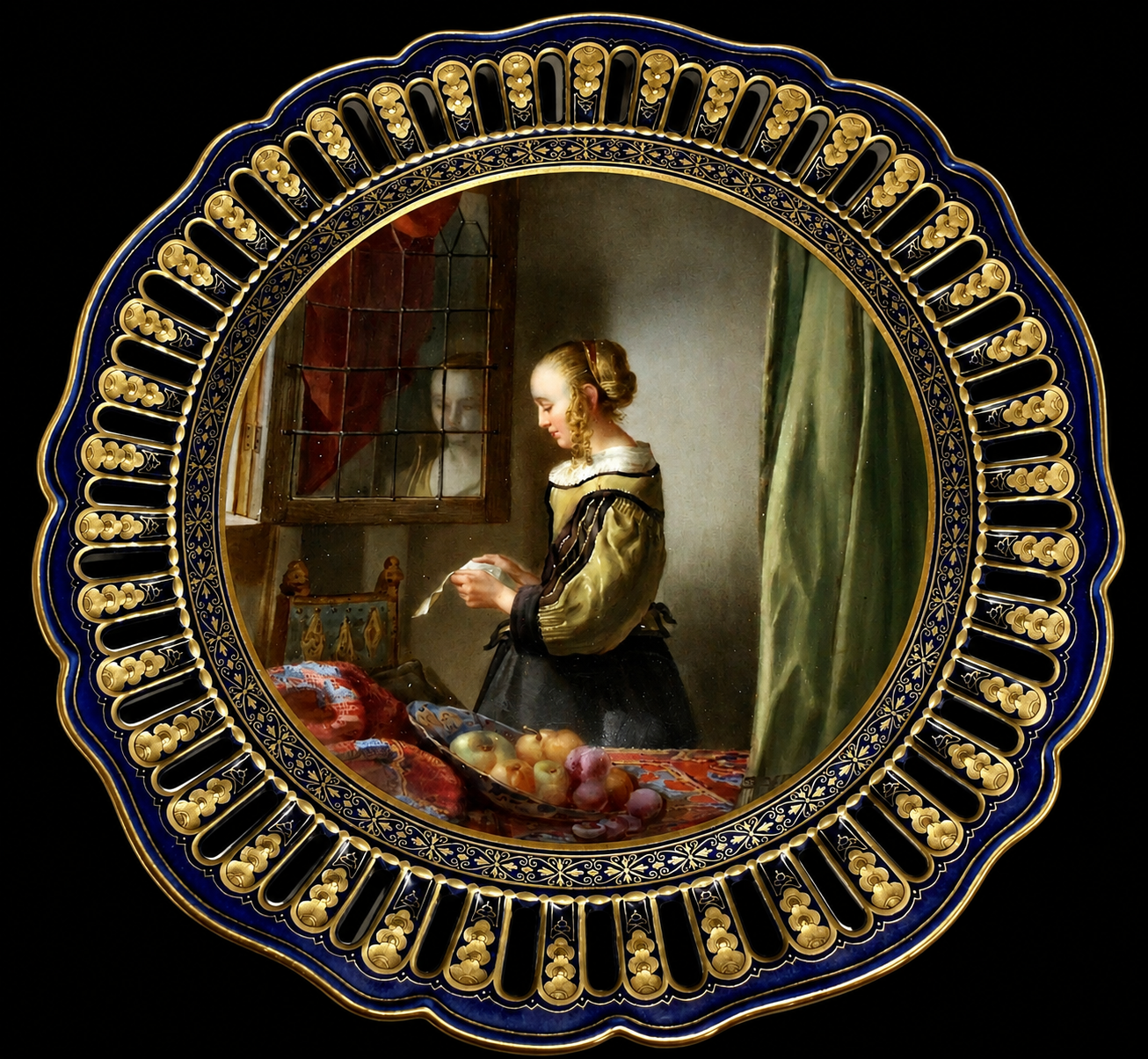
A finely decorated Meissen porcelain cabinet plate from the celebrated Old Master tradition, the central reserve painted after Johannes Vermeer with an intimate domestic interior depicting a young woman standing beside a leaded-glass window, holding a letter above a richly draped table laden with fruit. The composition is enclosed within an elaborate pierced border richly decorated in deep cobalt blue and heightened with extensive gilt ornament, scrolling foliage and stylized floral motifs, the shaped rim outlined in gilt.
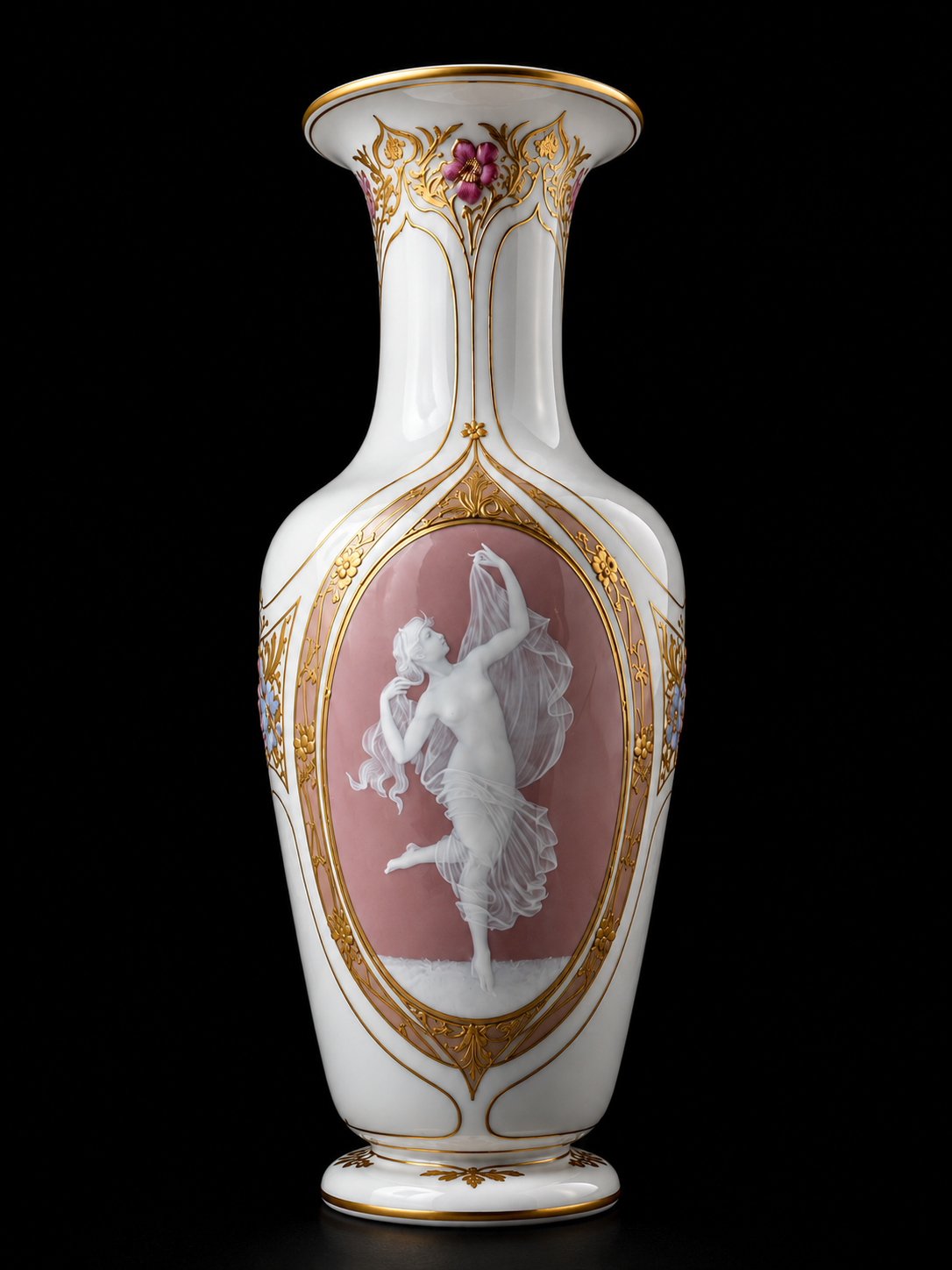
A Berlin KPM porcelain jewelled pate-sur-pate vase Circa 1890, marked with a sceptre in underglaze blue above an orb and KPM in red, further with various impressed and written marks, Gilt and painted in colours, the ovoid body decorated with a frontal beauty enclosing a pate-sur-pate scene signed H, the reverse with a bunch of botanical flowers, further applied with gilt rocailles and trelliswork in slight relief, enhanced with jewelled motifs, 13 inches high
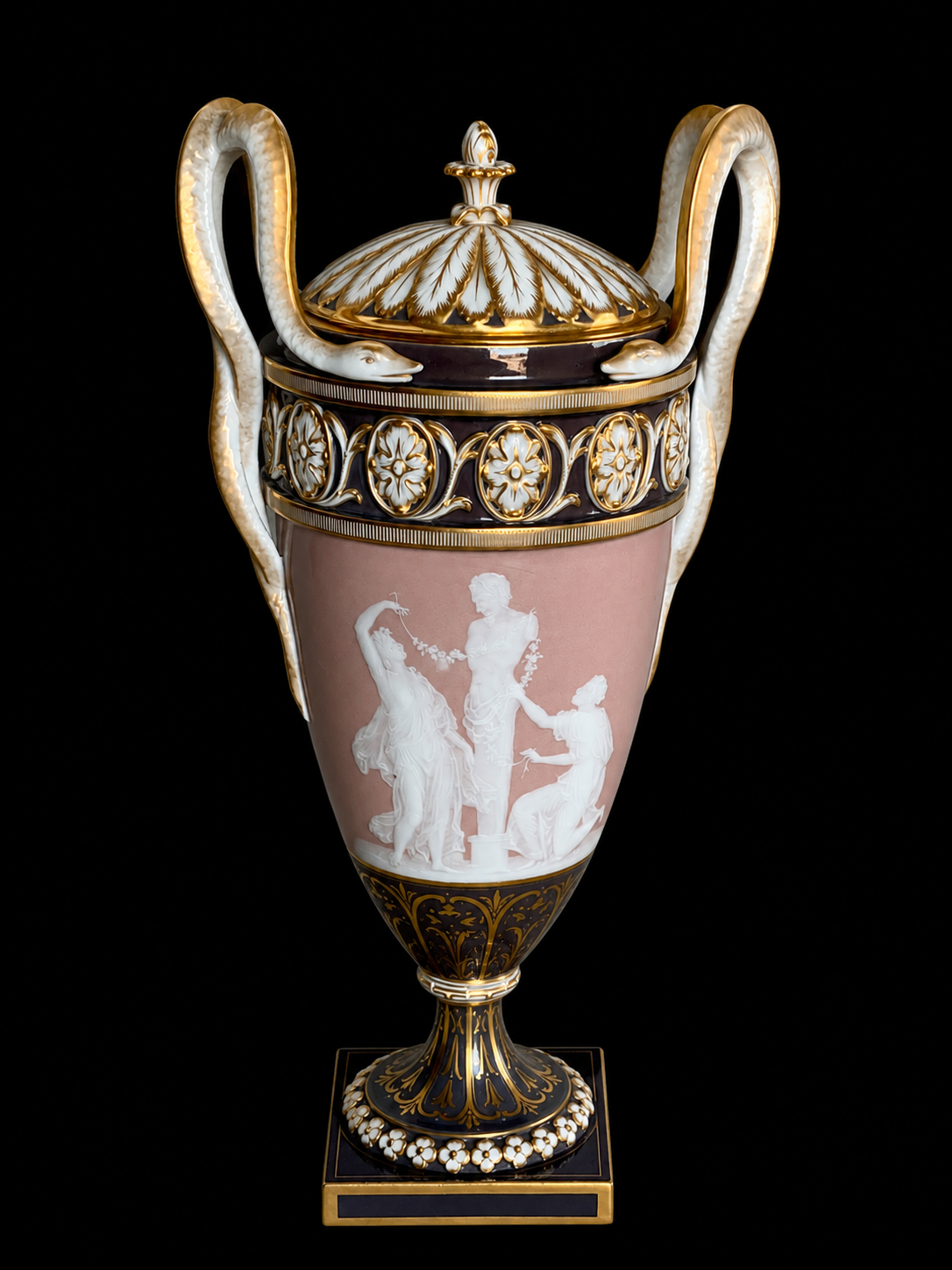
A MEISSEN PORCELAIN PINK-GROUND PATE-SUR-PATE VASE AND COVER LATE 19TH CENTURY, BLUE CROSSED SWORDS MARKS, PRESSNUMMERN 80 AND ...55Bifurcated double snake-form handle, finely painted and hand-tooled in white slip after Angelica Kauffman mythological scene,14. 3/8 in. (36.5 cm.) high
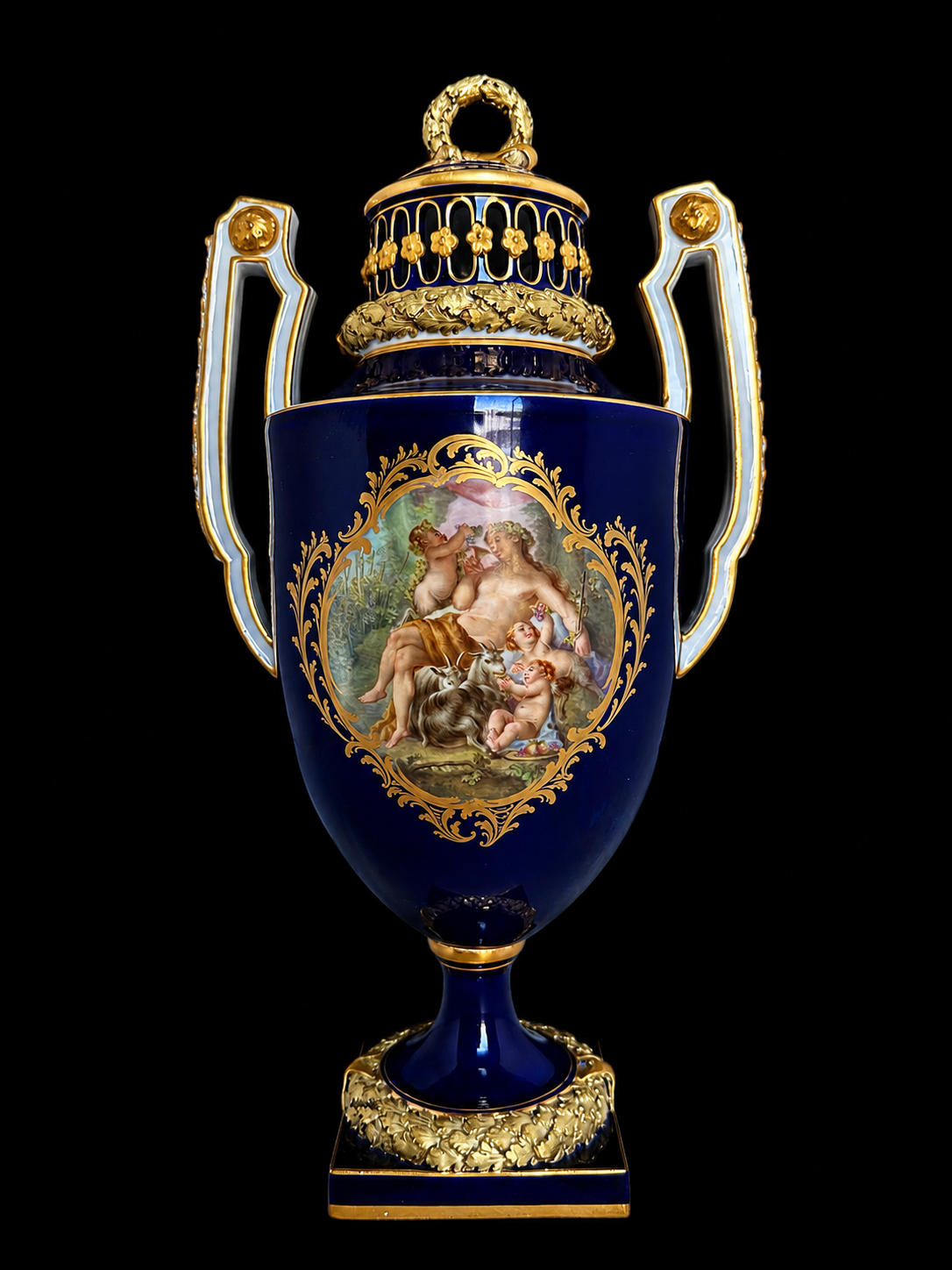
Amphora potpourri vase, Meissen, Knauff-Schwerter 1850-1924, 1st choice, model no. H 20, designed by Christian Gottfried and co-workers 1782-1785, oval body on round foot, framed by laurel wreath, on square pedestal, pierced lid, raised handles with rosettes on both sides, medallions on both sides with polychrome painted mythological scenes, cobalt blue background, ornamental gilding, 12 1/2 in. (32 cm.) high
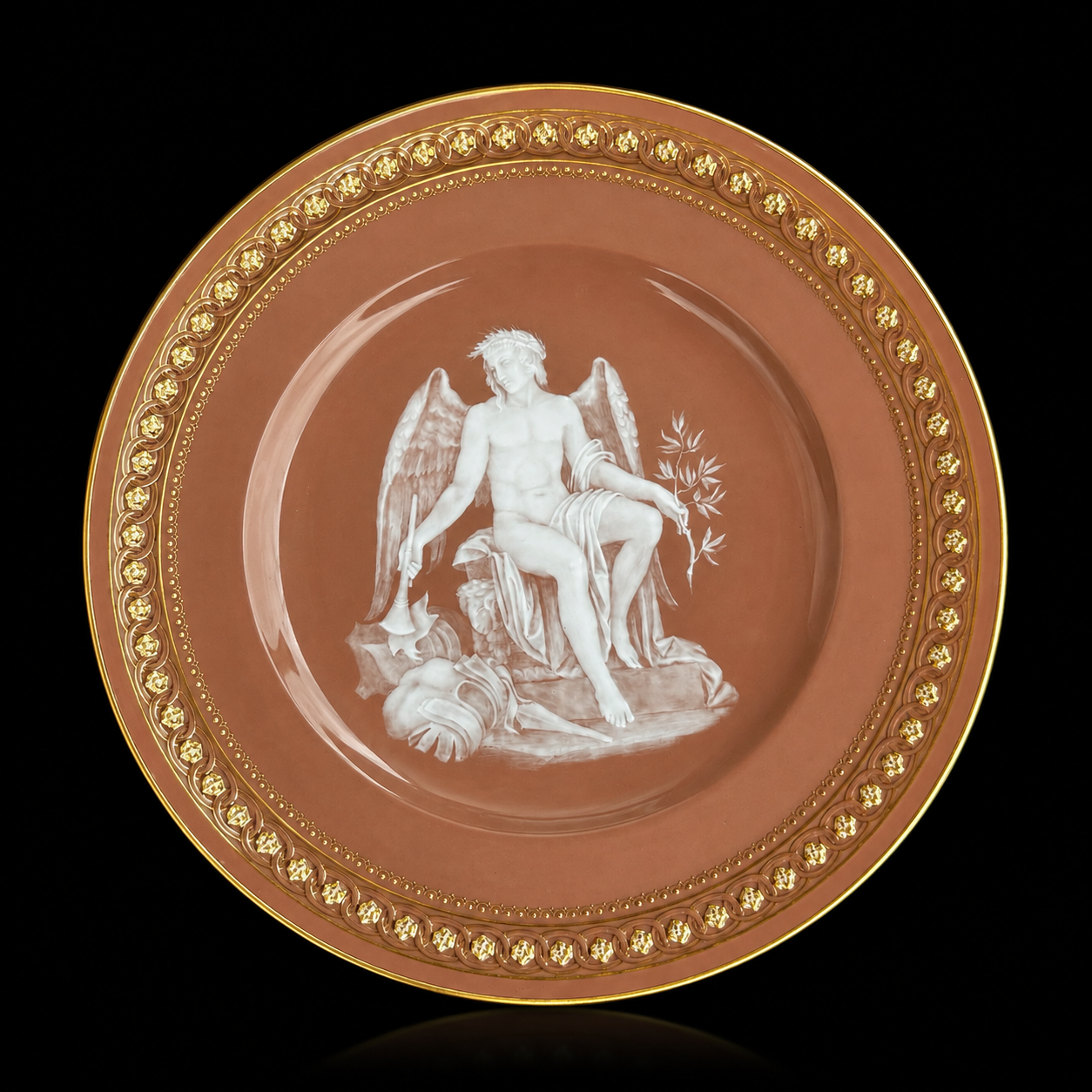
A fine 19th-century Meissen porcelain pâte-sur-pâte cabinet plate, measuring approximately 9.5 inches in diameter, finely decorated in the Neoclassical taste.
The center features an exceptionally detailed white pâte-sur-pâte classical figure of a seated winged youth, modeled in delicate relief against a rich terracotta-brown ground. The allegorical figure is depicted partially draped and holding a leafy branch, with a trumpet, helmet, shield and other martial attributes arranged below, creating a sophisticated composition inspired by Classical antiquity.
The cavetto is surrounded by an elaborate raised gilt border of scrolling interlaced ornament and repeating floral rosettes, further accented by delicate gilt beading and a finely gilded outer rim. The restrained palette and crisp white relief against the warm ground give the plate the appearance of an antique cameo.
Dimensions: 9.5 in. diameter (24.1 cm)
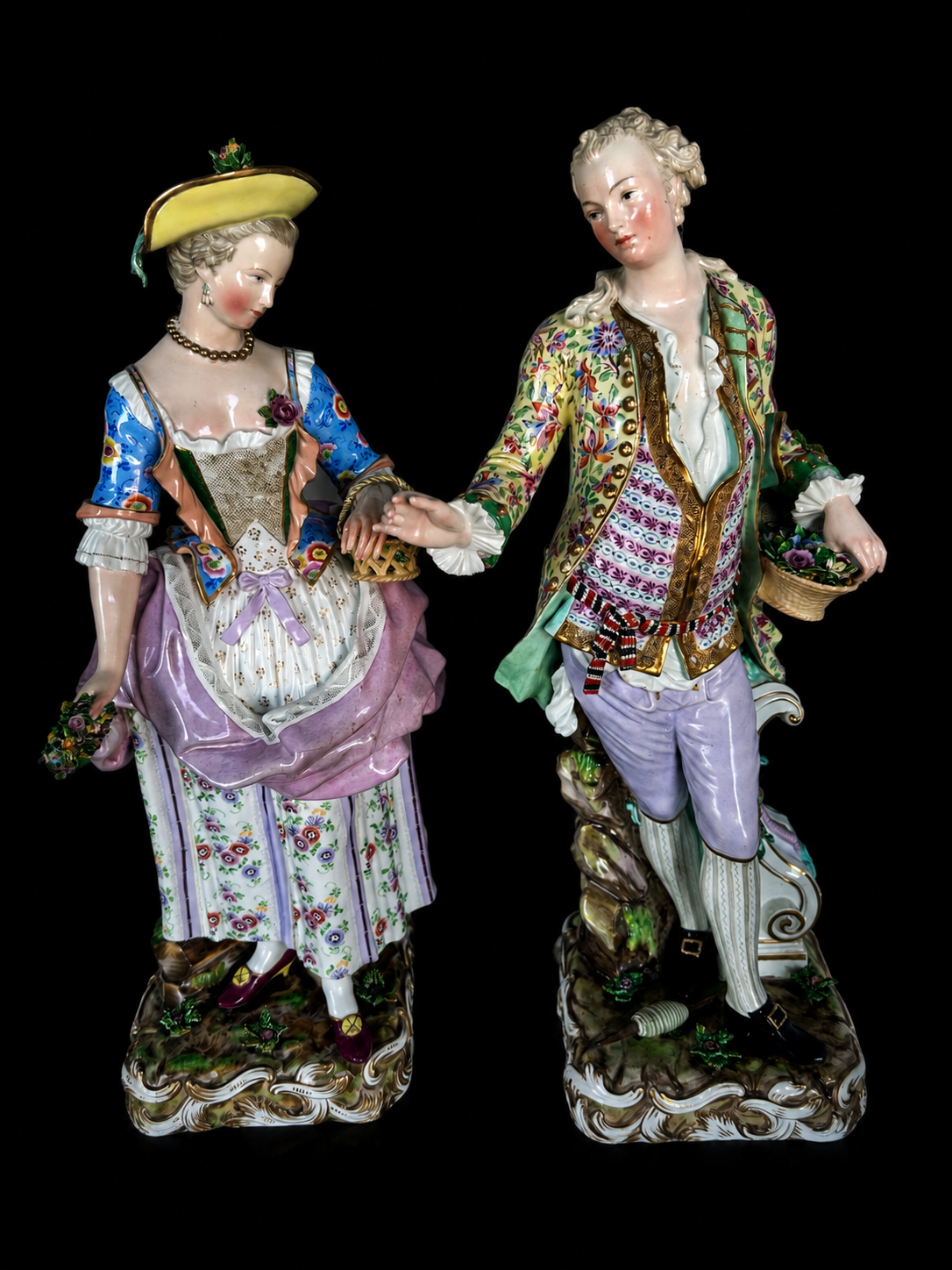
The couple dressed in floral attire in shades of lilac and pale yellow, each holding a basket of flowers, the man offering a posy, she with a wreath, on rocaille molded square bases 19 in. (48.3 cm.) high
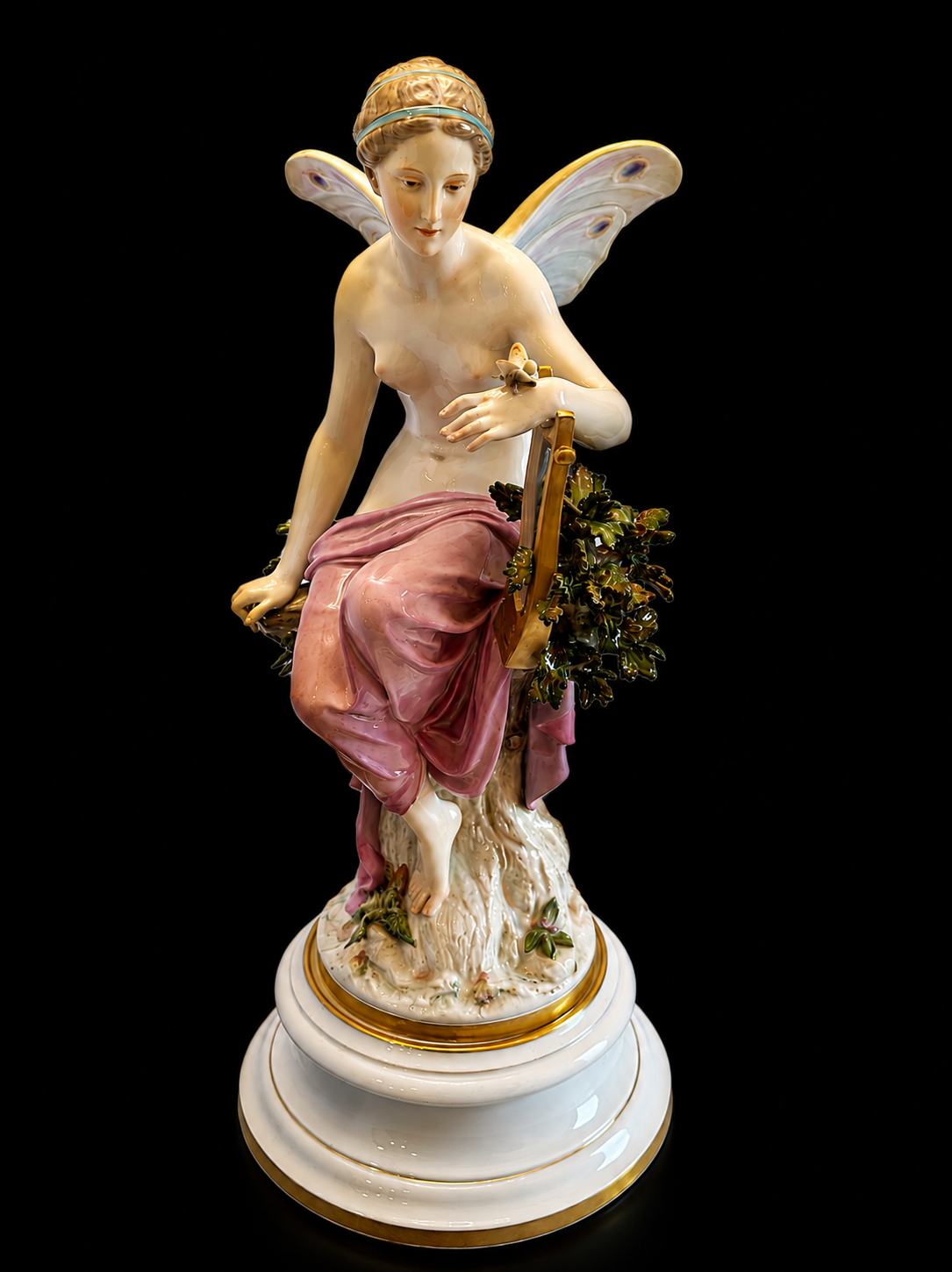
A MEISSEN FIGURE OF PSYCHE 19TH CENTURY, BLUE CROSSED SWORDS MARKS, INCISED R. HOLBE, DRESDEN, THE STAND IMPRESSED 19 The goddess modeled seated on a tree-stump and playing a harp, a butterfly perched on her hand, raised on a circular plinth 17¼ in. (43.8 cm.) high
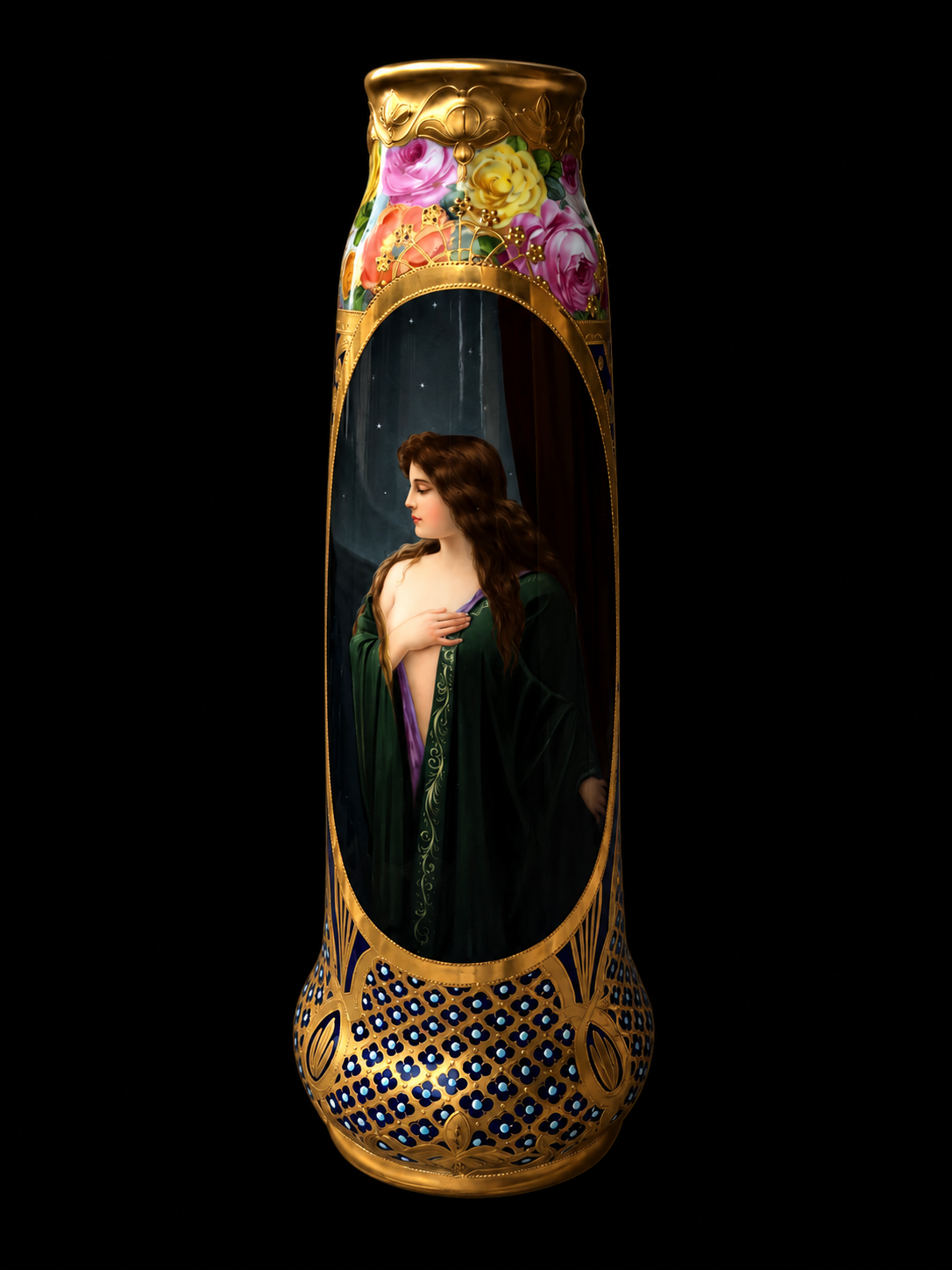
ANTIQUE ROYAL VIENNA COBALT-BLUE GROUND PORTRAIT VASE. LATE 19TH Century, BLUE UNDER-GLAZED BEEHIVE MARK, IMPRESSED 5521. AND S. Finely painted with a portrait of Mona Vanna, the cobalt blue ground enriched with gilt flowering and jeweled through out.13 in. high